

Warehouse operations in the UK are under persistent pressure. Labour shortages, rising customer expectations, compressed margins, and the relentless growth of e-commerce… UK online retail sales reached £128.6 billion in 2025, representing 29% of total retail — have pushed operators to look beyond traditional process improvement. The answer an increasing number of 3PL providers and warehouse managers are arriving at is artificial intelligence. Not as a distant ambition, but as live technology reshaping how goods are received, stored, picked, packed, and dispatched today.
The use of AI in warehouse management covers a wide spectrum: from machine-learning demand forecasting that adjusts stock positioning weeks in advance, to agentic AI systems that autonomously orchestrate labour, robotics, and order flows without waiting for human instruction. Understanding where each capability fits — and what it actually delivers… is what separates organisations making measurable gains from those still running pilots that never scale.
This guide covers the full picture: what AI in warehousing means in practice, how it improves operations, the measurable benefits, the role of warehouse automation AI, the emergence of agentic AI in warehouse management, and what the near future holds. Throughout, we’ll point to how platforms like Clarus WMS are making these capabilities accessible to UK 3PLs today, not in five years’ time.
What is AI in warehouse management?
AI in warehouse management is the application of machine learning, computer vision, predictive analytics, and autonomous decision-making to warehouse processes — enabling systems to learn from operational data, identify patterns, and take or recommend actions without manual intervention at every step. Unlike traditional WMS rules-based logic, AI adapts continuously as conditions change.
To understand the scope, it helps to know what a Warehouse Management System does in the first place. A WMS is the operational backbone of a warehouse… it directs receiving, putaway, picking, packing, despatch, and inventory tracking. AI builds an intelligent layer on top of that backbone, making it responsive rather than reactive.
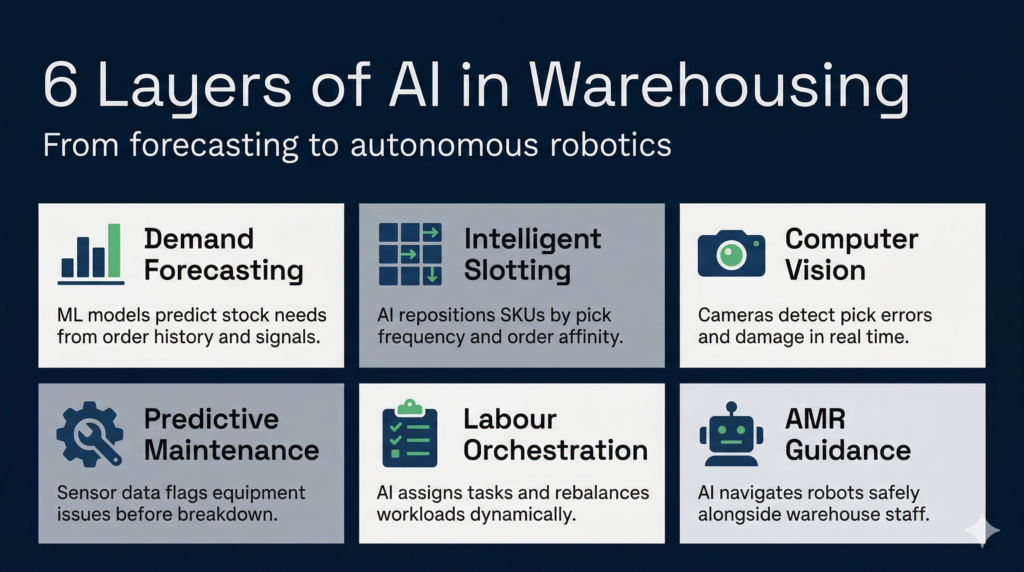
In practical terms, ai tools for warehouse management fall into several categories:
- Demand forecasting and inventory optimisation — machine learning models analyse historical order data, seasonality, and external signals to predict stock requirements, reducing both overstock and stockouts.
- Intelligent slotting — AI analyses pick frequency and SKU affinity to recommend or automatically adjust storage locations, shortening travel distances and improving throughput.
- Computer vision and quality control — cameras combined with AI detect picking errors, damaged stock, or incorrect label placement in real time.
- Predictive maintenance — sensors feed equipment performance data into AI models that flag maintenance needs before breakdowns occur, reducing unplanned downtime.
- Labour management and task orchestration — AI dynamically assigns picking tasks, adjusts workload distribution based on real-time queue depth, and identifies bottlenecks across shift patterns.
- Autonomous mobile robots (AMRs) and robotics guidance — AI powers the navigation and decision-making of warehouse robots, enabling them to operate safely alongside people and adapt routes in real time.
The UK Warehousing Association’s Warehouse of the Future white paper identifies AI and robotics as central to improving safety and efficiency across UK warehousing, with adoption already reshaping warehouse design and the role of human labour in distribution centres of all sizes.
How does AI improve warehouse operations?
AI improves warehouse operations by shifting from reactive, rules-based management to predictive, adaptive decision-making. It reduces manual handling of repetitive decisions, cuts error rates, accelerates throughput, and allows warehouse teams to focus on exceptions and strategic work rather than operational firefighting.
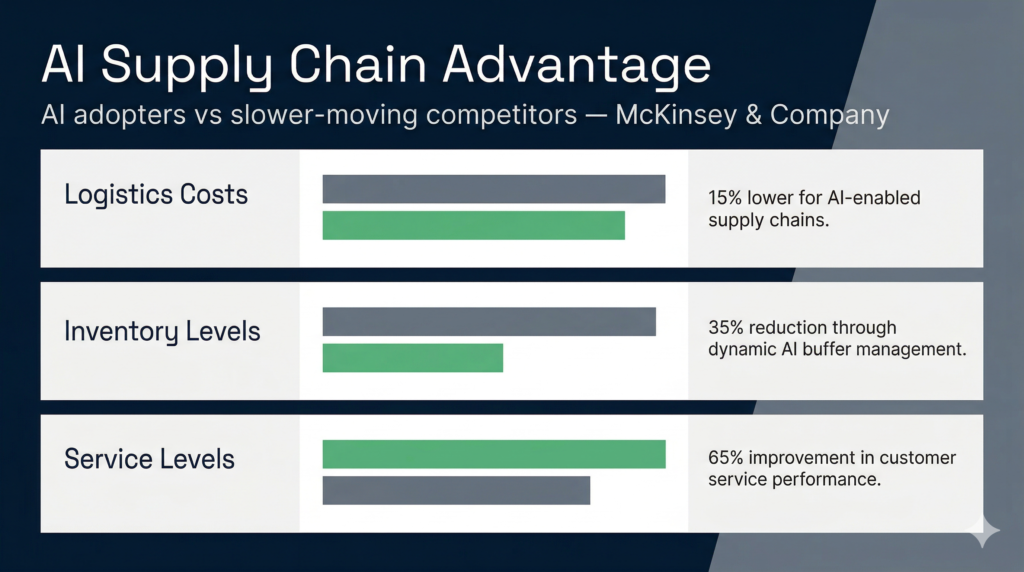
The gains are well-documented. Research from McKinsey & Company’s analysis of AI supply chain adoption found that early adopters of AI-enabled supply chain management improved logistics costs by 15%, reduced inventory levels by 35%, and improved service levels by 65% compared with slower-moving competitors. These are not marginal gains — they represent the difference between a 3PL that retains clients and one that loses them to more agile competitors.
Smarter inventory positioning
Traditional WMS slotting relies on static rules — fast-movers in Zone A, slow-movers in Zone C. AI in warehouse optimisation replaces static rules with dynamic ones. The system continuously analyses pick frequency, order co-occurrence (which SKUs are picked together), weight and size constraints, and seasonal demand shifts, then recommends or executes slot changes automatically. The result is shorter pick paths, fewer pick errors, and faster order cycle times.
For a 3PL managing multiple client profiles with different SKU mixes and seasonal patterns, intelligent slotting is particularly valuable. Dynamic repositioning can accommodate a fashion client’s peak in November and a garden equipment client’s peak in March within the same facility, without manual reconfiguration of storage rules.
Demand forecasting that accounts for what you cannot see
Human planners excel at incorporating known events — promotions, seasonal peaks, new contract wins. What they struggle with is the accumulation of subtle signals: micro-trends in order velocity, shifting regional demand patterns, or early indicators of a supply disruption. Machine learning demand forecasting ingests all of these signals simultaneously, producing forecasts that consistently outperform human or spreadsheet-based models.
The MHI 2025 Annual Industry Report, based on surveys of over 700 manufacturing and supply chain leaders, identified inventory and network optimisation as one of the three top areas where companies are adopting or planning to adopt AI in the next five years — reflecting how central forecasting intelligence has become to operational strategy.
Labour efficiency and real-time task management
AI tools for warehouse management also address one of the most persistent challenges in UK warehousing: labour. The same MHI report found that talent shortages and hiring difficulties are rated as extremely challenging by over 45% of warehouse operators, with more than half citing unfilled headcount as the primary automation catalyst. AI addresses this not by replacing people wholesale, but by making every person on the floor more productive — directing them to the right task at the right moment, balancing workloads across teams in real time, and flagging when a picking queue is about to create a despatch bottleneck.
What are the benefits of AI in warehouse management?
The core benefits of AI in warehouse management are measurable: lower operating costs, higher throughput, improved accuracy, and greater resilience. Organisations that embed AI across their warehouse processes report reductions in logistics costs, fewer inventory errors, shorter order cycle times, and reduced dependence on manual intervention to manage disruption.
| Operational area | Traditional WMS approach | AI-enhanced approach | Typical improvement |
|---|---|---|---|
| Demand forecasting | Historical averages, manual adjustment | Machine learning across multiple data signals | 20-50% reduction in forecast error |
| Inventory levels | Safety stock calculated manually | Dynamic buffer management by AI | Up to 35% reduction in inventory (McKinsey) |
| Logistics costs | Fixed routing and carrier rules | AI-optimised routing and load consolidation | Up to 15% cost reduction (McKinsey) |
| Pick accuracy | Manual verification, paper-based checks | Computer vision and AI-guided picking | Error rates reduced to sub-0.1% |
| Labour productivity | Static task assignment, supervisor-led rebalancing | Real-time AI task orchestration | 15-25% throughput increase (industry estimate) |
| Equipment uptime | Scheduled maintenance intervals | Predictive maintenance via sensor AI | Significant reduction in unplanned downtime |
Benefits specific to 3PL operations
For third-party logistics providers, AI in warehouse management delivers an additional layer of benefit: client visibility and reporting. 3PLs operating a 3PL management system with embedded AI can generate real-time client dashboards showing stock accuracy, SLA adherence, and exception alerts — moving the client relationship from monthly reporting to continuous, data-driven transparency.
This transparency is increasingly expected. Clients who can see inside your warehouse operations in real time are clients who renew contracts. AI-generated reporting removes the manual overhead of producing this data while improving its accuracy and timeliness.
Cost reduction without headcount reduction
A common concern among warehouse managers is that AI-driven automation means workforce reduction. In practice, the leading 3PLs are using AI to handle volume growth without proportional headcount increases — absorbing more orders with the same team by making existing staff more effective. Warehouse automation AI enables a 3PL to scale capacity during peak periods without hiring large numbers of temporary staff whose productivity takes weeks to reach full speed.
Effective inventory and warehouse management powered by AI also reduces the cost of errors: mis-picks, over-ordered stock, and incorrect putaway all carry direct financial consequences that AI significantly reduces.
What role does AI play in warehouse automation?
AI is the intelligence layer that makes warehouse automation work at scale. Automation hardware — conveyor systems, autonomous mobile robots, goods-to-person systems, automated storage and retrieval systems — executes physical tasks. AI decides what those systems should do, in what order, and how to adapt when conditions change.
Without AI, automated hardware operates on fixed rules that break down when order profiles shift, stock locations change, or unexpected events occur. AI warehouse automation introduces dynamic decision-making: the system reasons across multiple variables simultaneously and adjusts robot routing, pick prioritisation, and replenishment triggers in real time.
How AI enables robots to work alongside people
Modern autonomous mobile robots navigate using AI-powered computer vision and simultaneous localisation and mapping (SLAM), allowing them to build and update their understanding of the warehouse environment dynamically. When a pallet is left in an aisle or a new rack section is added, an AI-driven AMR adapts its routing within seconds rather than requiring manual reprogramming.
The global warehouse automation market was valued at $26.5 billion in 2024 and is projected to grow at 15.9% compound annual growth rate through to 2034 (Source: GM Insights). Much of this growth is driven by AI making automation more accessible and adaptable — lower barriers to deployment mean smaller 3PLs can now implement intelligent automation that previously required large capital investments and specialist integrators.
AI in picking and packing
AI-guided pick systems — including voice picking, vision picking, and light-directed picking enhanced by AI decision engines — direct operators to the correct location, verify the correct item through computer vision, and flag exceptions without manual supervisor intervention. This reduces pick errors, accelerates cycle time, and creates a complete digital audit trail that supports client SLA reporting.
For 3PLs evaluating how to choose the right platform for these capabilities, our guide to choosing a WMS covers the key functional requirements to assess — including AI readiness — when shortlisting warehouse management software.
How is agentic AI used in warehouse management?
Agentic AI in warehouse management refers to AI systems that do not just recommend actions but autonomously execute multi-step workflows — perceiving the current state of the warehouse, reasoning across competing priorities, and acting without requiring human approval at each step. This is the frontier of warehouse AI, and it is moving faster than most operators realise.
Traditional AI tools provide recommendations: “Consider repositioning SKU 4821 to Zone B.” Agentic AI takes the action: it identifies that a seasonal demand shift is underway, recalculates optimal slot positions across the affected SKU range, queues a putaway task for the next available operative, updates the WMS location records, and notifies the client portal — all without human initiation.
The scale of the shift is confirmed by Gartner’s April 2026 forecast: supply chain management software with agentic AI capabilities is projected to grow from less than $2 billion in 2025 to $53 billion in spend by 2030. Gartner also predicts that 60% of enterprises using SCM software will have adopted agentic AI features by 2030, up from just 5% in 2025 (Source: Gartner, April 2026).
What enables agentic AI in a WMS?
Agentic AI requires a platform architecture that exposes warehouse operations data and actions through a structured, machine-readable interface. Without this, AI agents cannot read the current state of the warehouse, reason about it, or execute actions inside the WMS. This is precisely the problem that Clarus WMS’s Model Context Protocol (MCP) Server layer solves.
The Clarus MCP Server exposes warehouse data and operational actions as a structured context layer that AI agents can consume and act upon. This means an AI agent — whether built on a large language model, a specialised reasoning engine, or a custom workflow — can query live stock levels, read outstanding order queues, identify bottlenecks, and trigger WMS actions directly. It is the difference between an AI that can observe your warehouse and one that can actually operate within it.
For UK 3PLs evaluating a WMS implementation, understanding whether the system architecture supports agentic AI integration is now a material consideration — not a future-proofing checkbox, but a live capability that affects what you can automate today and how rapidly you can expand that automation as AI tooling matures.
Agentic AI use cases already live in warehousing
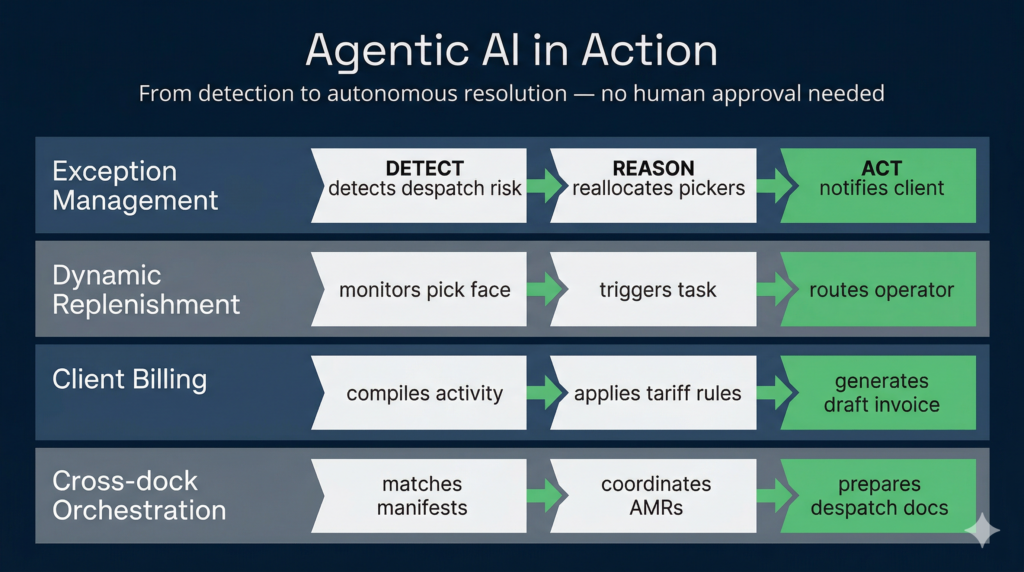
- Autonomous exception management — when a despatch deadline is at risk due to a picking delay, an agentic AI system detects the shortfall, reallocates available pickers from lower-priority tasks, adjusts the wave plan, and notifies the client — without supervisor involvement.
- Dynamic replenishment — AI agents monitor pick face stock levels in real time, trigger replenishment tasks at the optimal moment (before stockout rather than after), and route the replenishment to the nearest available operator with the correct equipment.
- Automated client billing and reporting — agentic systems compile activity data across a billing period, apply client-specific tariff rules, generate draft invoices, and flag anomalies for human review — compressing a multi-hour manual process to minutes.
- Cross-dock orchestration — for inbound shipments that need to flow directly to outbound without storage, agentic AI matches inbound manifests to outstanding orders, assigns unloading bays, coordinates AMR routing, and prepares despatch documentation autonomously.
What is the future of AI in warehousing?
The future of AI in warehousing is one of increasing autonomy, tighter system integration, and expanding accessibility. The technologies that are today deployed in large, well-resourced distribution centres will within three to five years be accessible to mid-market 3PLs through cloud-native WMS platforms with embedded AI capabilities and open integration architectures.
Gartner’s 2025 supply chain technology trends report identified agentic AI, ambient invisible intelligence, and augmented connected workforces as the defining technology trends shaping warehousing and logistics through to 2030 (Source: Gartner, March 2025). These are not independent trends — they converge: ambient sensors feed AI agents with real-time environmental data, agentic systems act on that data, and augmented workers receive AI-generated guidance through wearables and handheld devices.
AI will resolve supply chain disruptions autonomously
Current AI systems alert humans to disruptions and recommend responses. The trajectory is towards systems that detect, reason, and resolve — closing the loop without human initiation. Gartner forecasts that by 2028, 15% of day-to-day supply chain decisions will be made autonomously by AI agents. In warehousing terms, this means routine exception management, replenishment, task allocation, and client reporting increasingly happen without a manager approving each action.
AI accessibility for mid-market 3PLs
The barrier to AI adoption has historically been infrastructure cost and data quality. Cloud-native WMS platforms with built-in AI modules, pre-trained models fine-tuned on logistics data, and open API or MCP-style integration layers are changing this. A UK 3PL running Clarus WMS does not need a data science team or a bespoke AI development project to benefit from AI warehouse optimisation — the platform delivers intelligent slotting, demand signal integration, and agentic workflow enablement as part of the core product.
The human role shifts, not disappears
AI does not eliminate the need for warehouse professionals — it elevates it. As agentic AI handles routine orchestration, warehouse managers increasingly operate as exception handlers, strategic decision-makers, and client relationship leads. The skills premium shifts from manual dexterity and physical throughput to data literacy, exception judgement, and client management. This is reflected in UKWA’s workforce research: skills shortages in automation and robotics are already being cited as a critical challenge by UK warehouse operators, with over half anticipating shortfalls within five years (Source: UKWA Warehouse of the Future white paper).
The 3PLs who navigate this transition most successfully will be those whose WMS platform grows with them — adding AI capability incrementally rather than requiring a wholesale system replacement every time warehouse AI advances.
Is your WMS ready for AI-powered warehousing?
The question most UK 3PL operators should be asking is not whether AI in warehouse management is worth pursuing — the evidence is clear that it is. The question is whether their current platform can support it. A WMS that cannot expose its data to AI agents, that lacks real-time event streaming, or that requires manual configuration for every operational exception will become a bottleneck as AI tooling matures.
Clarus WMS is built for this moment. Designed specifically for UK 3PL operations, Clarus combines a full-featured warehouse management system with an MCP Server architecture that makes your warehouse data available to AI agents and automation tools without bespoke development. Whether you are looking to implement AI warehouse automation incrementally — starting with intelligent slotting and demand forecasting — or you want to explore agentic AI workflows that act autonomously across your operation, Clarus provides the platform foundation to do it.
If you would like to see how Clarus WMS supports AI-ready warehouse operations for UK 3PLs, book a demonstration with our team. We’ll walk you through how the MCP Server layer works, what AI workflows it enables today, and how your operation can progress along the automation and AI maturity curve at a pace that suits your business.