

The best warehouse management system software balances operational depth with ease of deployment, connecting inventory control, order fulfilment, and labour management into a single platform. With the global WMS market valued at USD 3.38 billion in 2025 and growing at 21.9% CAGR (Grand View Research), the range of available platforms has never been wider. This guide breaks down the top options by operation type — enterprise, 3PL, and SME — so you can focus your evaluation on platforms that match your scale.
What is the best warehouse management system software in 2026?
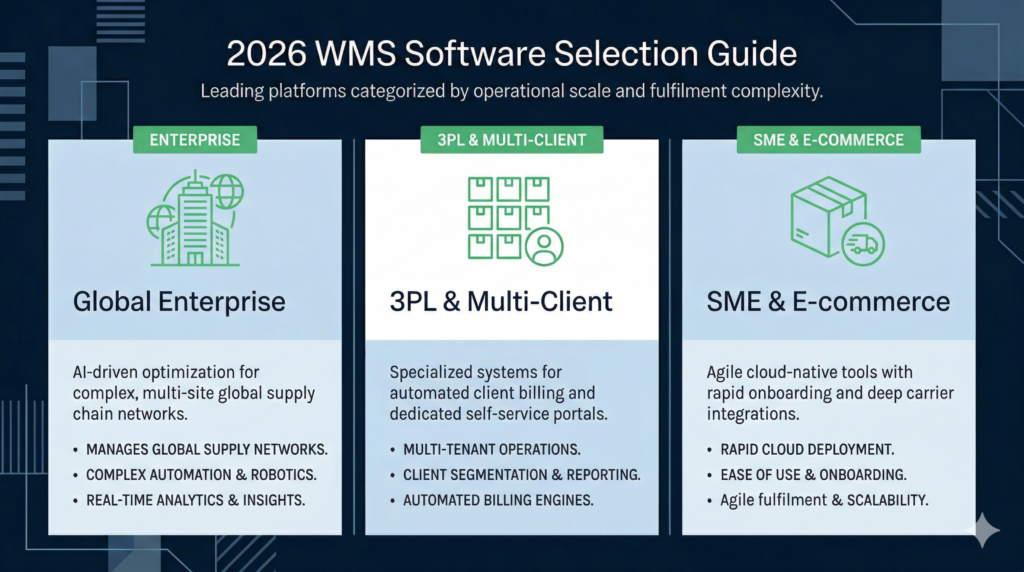
The best WMS depends on your operation type. Manhattan Active WMS leads for large enterprise, Clarus WMS and Extensiv excel for 3PL operations, and platforms like Mintsoft and Zoho Inventory serve SME warehouses effectively. No single platform dominates every category.
How do the top WMS platforms compare by operation type?
| Platform | Operation type | Deployment | Key differentiator | Indicative pricing |
|---|---|---|---|---|
| Manhattan Active WMS | Large enterprise | Cloud-native | Gartner MQ Leader 17 times, AI-driven optimisation | Custom (enterprise pricing) |
| SAP Extended Warehouse Management | Enterprise (SAP ecosystem) | Cloud / on-premise | Deep ERP integration, complex supply chains | Custom (enterprise pricing) |
| Oracle NetSuite WMS | Mid-market to enterprise | Cloud | Unified ERP + WMS, highest usability ratings | From £1,500/month |
| Clarus WMS | 3PL, multi-client enterprise | Cloud-native | Purpose-built 3PL billing, rapid deployment | From £1,000/month |
| Extensiv 3PL Warehouse Manager | 3PL providers | Cloud | Multi-client management, carrier integrations | From £500/month |
| Deposco | Mid-market 3PL, e-commerce | Cloud | Client onboarding in as little as two hours | Custom pricing |
| Mintsoft (Access Group) | SME, e-commerce fulfilment | Cloud | UK-built, strong carrier integrations, affordable | From £200/month |
| Zoho Inventory | Small businesses | Cloud | Low cost, multi-channel selling integration | From £50/month |
For verified user reviews and feature comparisons, directories such as Gartner Peer Insights, Capterra UK, and Software Advice provide detailed ratings from real warehouse professionals.
What features should the best WMS include?
A warehouse management system earns a “best” rating when it delivers core warehouse operations reliably while offering the flexibility to handle your specific workflows. Feature checklists matter less than how well the system handles your day-to-day reality.
Essential features across all WMS categories
- Receiving and putaway — barcode-driven goods-in processing with configurable putaway rules based on product type, velocity, or client requirements
- Inventory management — real-time stock visibility across locations, lot and batch tracking, expiry date management, and cycle counting
- Order picking — support for wave, batch, zone, and cluster picking with optimised pick paths to reduce travel time
- Packing and dispatch — automated carrier selection, label generation, and shipping documentation with proof-of-dispatch confirmation
- Returns processing — structured workflows for receiving returns, quality inspection, and restocking or disposal decisions
- Reporting and analytics — real-time dashboards covering picks per hour, dock-to-stock time, order accuracy, and labour utilisation
What separates enterprise WMS from mid-market platforms?
| Capability | Enterprise WMS | Mid-market WMS |
|---|---|---|
| Multi-site management | Global warehouse network with centralised control | Typically 1–5 sites |
| Automation integration | Native AMR, AS/RS, and conveyor integration | API-based or limited |
| Labour management | Engineered standards, incentive tracking | Basic productivity reporting |
| Configuration depth | Highly customisable workflows per site | Template-based with some customisation |
| Implementation time | 6–18 months | 4–12 weeks |
Which WMS is best for 3PL warehouse operations?
Third-party logistics providers need WMS platforms that handle multi-client complexity natively — not as an afterthought bolted onto a single-client system. The 3PL segment held the largest WMS market share in 2024 (Grand View Research), reflecting the sector’s heavy reliance on specialised software.
The critical capabilities that separate 3PL-grade WMS from general warehouse software include:
- Multi-client inventory segregation — each client’s stock managed independently within shared warehouse space, with separate SKU catalogues and location rules
- Automated client billing — configurable billing engines that calculate storage charges, handling fees, and value-added services per client, generating invoices automatically
- Client self-service portals — secure dashboards where your customers can view their inventory levels, track orders, and run reports without contacting your team
- Flexible SLA management — different service levels, cut-off times, and priority rules for each client
Clarus WMS was designed from the ground up for 3PL operations. Our multi-client architecture means every feature — from billing to reporting to workflow configuration — works at the client level without workarounds. A fulfilment provider managing eight e-commerce brands from one warehouse deployed Clarus WMS and achieved a 40% reduction in order processing time within the first quarter, primarily through automated wave planning that groups orders by client, carrier, and service level simultaneously.
How do you evaluate WMS software before buying?
The evaluation process should test the system against your actual operations, not theoretical scenarios. Too many WMS implementations fail because the selection was based on feature checklists rather than operational fit.
A practical WMS evaluation framework
- Define your non-negotiables — list the 5–7 capabilities you absolutely cannot operate without (e.g., multi-client billing, carrier API integration, lot tracking)
- Request scenario-based demos — ask vendors to demonstrate your specific workflows, not their standard demo script
- Test integration capabilities — verify how the WMS connects with your ERP, e-commerce channels, and carrier systems before committing
- Check reference clients — speak with existing customers in your industry and of similar size
- Evaluate total cost of ownership — include implementation, training, integration, and ongoing support costs alongside licence fees
- Assess the vendor’s roadmap — understand how frequently the platform is updated and whether updates require downtime
Reviews on Gartner Peer Insights are particularly valuable during evaluation because they include detailed implementation feedback alongside feature ratings, giving you a realistic picture of what to expect during deployment.
What does WMS implementation typically involve?
Implementation timelines and complexity vary significantly between cloud-native and on-premise platforms. Cloud WMS solutions from vendors like Deposco can onboard individual clients in as little as two hours, while full enterprise deployments may take 12–18 months.
A typical cloud WMS implementation follows this sequence:
- Discovery and scoping (1–2 weeks) — mapping your current workflows, integration requirements, and data migration needs
- System configuration (2–4 weeks) — setting up warehouses, locations, products, users, and workflow rules
- Integration build (2–6 weeks) — connecting the WMS to your ERP, e-commerce platforms, and carrier systems via APIs
- User acceptance testing (1–2 weeks) — your team validates the system against real scenarios
- Go-live and support (1 week) — supervised launch with vendor support on-site or remote
The UK WMS market is increasingly favouring rapid-deployment cloud platforms. Mintsoft, built by UK-headquartered The Access Group, serves over 160,000 small and medium businesses and emphasises fast onboarding as a core selling point.
Ready to find the best WMS for your warehouse?
The best warehouse management system is the one that fits your operation today and scales with your growth. If you run a 3PL or manage multiple clients from shared warehouse space, a purpose-built platform will always outperform a generic system adapted for multi-client use.
Clarus WMS gives 3PLs and enterprise warehouses the multi-client depth, automated billing, and rapid deployment that generic platforms cannot match. Book a demo to see how Clarus WMS handles your specific workflows — we use your data, not a generic demo environment.
References
- Warehouse Management System Market Size Report, 2033 — Grand View Research. Link
- Best Warehouse Management Systems Reviews 2026 — Gartner Peer Insights. Link
- Warehouse Management System — Capterra UK. Link
- Warehouse Management System Comparison — Software Advice. Link
- Best 3PL Warehouse Management Systems of 2026 — Deposco. Link
- 5 Best Warehouse Management Systems for 3PLs in 2026 — Robotics and Automation News. Link
- The 7 Best Warehouse Management Software in 2026 — Digit Software. Link