

When you’re running an online store, success hinges on picking the right ecommerce solution provider. Whether you’re a start-up testing the market or an established retailer scaling to new channels, the tools and support you choose make the difference between struggling to keep up and thriving. This guide explores what an ecommerce solution provider actually does, how to evaluate your options, and how the right platform integrates with your entire supply chain to deliver accuracy and speed your customers expect.
What Is an Ecommerce Solution Provider?
An ecommerce solution provider is a company that supplies the software, infrastructure, and services you need to run an online business. Unlike a basic shopping cart tool, a true provider handles the full stack: your storefront, payment processing, inventory management, order routing, customer data, and integration with back-office systems like accounting and logistics.
The best providers don’t just sell you software. They partner with you to solve real problems. They understand your customer journey, from browsing through checkout and post-purchase support. They know that behind every order lies a complex chain of decisions about stock allocation, warehouse picking, packing, and shipping. A comprehensive ecommerce solution provider bridges the gap between what your customer sees online and what happens in your warehouse.
For many businesses, especially those using third-party logistics (3PL), this integration is critical. Your ecommerce platform must talk to your warehouse management system, your shipping provider, and your accounting software without manual intervention or error-prone data entry.
Types of Ecommerce Solutions Available
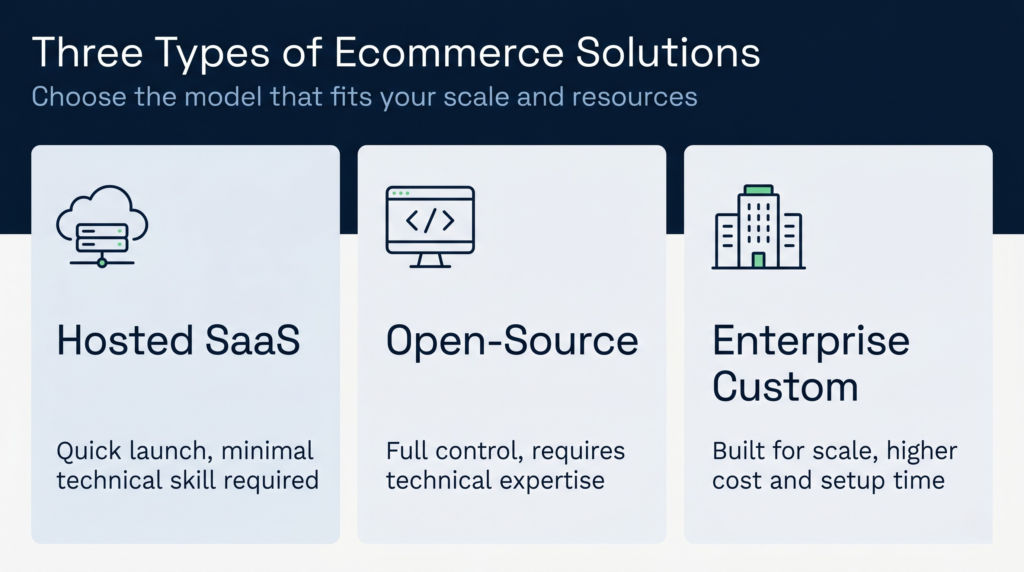
Not every ecommerce solution is built the same way. Understanding the different types helps you narrow down what fits your business model.
Hosted and SaaS Platforms
Hosted platforms like EKM handle everything for you. You log in, upload your products, and your store is live. The provider manages security, uptime, backups, and updates. You pay a monthly fee, and the provider handles the infrastructure. This approach is quick to launch and requires no technical expertise, though you’re limited by what the platform allows you to customize.
Open Source and Self-Hosted Solutions
Some businesses prefer to host their own software. Platforms like Magento or WooCommerce give you more control but require technical resources to maintain, update, and secure. You own the data and the code, but you’re also responsible for the server bills and hiring developers when things go wrong.
Enterprise and Custom Ecommerce Solutions
For large retailers or those with unique requirements, custom ecommerce solutions built specifically for your business are available. Companies like Sana Commerce and NetSuite Commerce offer flexible, enterprise-grade systems that integrate tightly with ERP and accounting software. The trade-off is higher cost and longer implementation timelines, but you get a system built for scale.
B2B Ecommerce Software Solutions
B2B selling is different from B2C. Buyers want custom pricing, bulk discounts, payment terms, and integration with their own procurement systems. B2B ecommerce software solutions handle complex workflows like quote requests, approval processes, and recurring orders. These platforms are purpose-built for the nuances of business-to-business transactions.
Understanding User Journeys and Customer Experience
Your choice of ecommerce solution provider directly shapes how your customers experience your brand. A poor user journey frustrates buyers and kills conversions.
Start with discovery. Your platform should offer smart search, filtering by attributes (size, colour, brand), and recommendations based on browsing or purchase history. Personalisation isn’t just nice-to-have anymore; it’s expected. If a customer visits your site twice, they expect you to remember them.
The checkout experience makes or breaks sales. Complex forms, unclear shipping costs, and surprise fees at the last moment cause cart abandonment. The best providers offer one-click checkout, transparent cost breakdowns, and multiple payment methods including digital wallets. Mobile matters too. Most traffic comes from phones now, so your solution must deliver a flawless mobile experience without slowing down on slower networks.
After purchase, the journey continues. Customers want clear order confirmation emails, tracking updates, and an easy way to contact you if something goes wrong. Your ecommerce platform should automate these touchpoints and give customers visibility into their delivery. When you integrate your platform with a 3PL management system, you can push real-time shipping updates and proof of delivery directly to the customer.
Comparing Online Selling Platforms
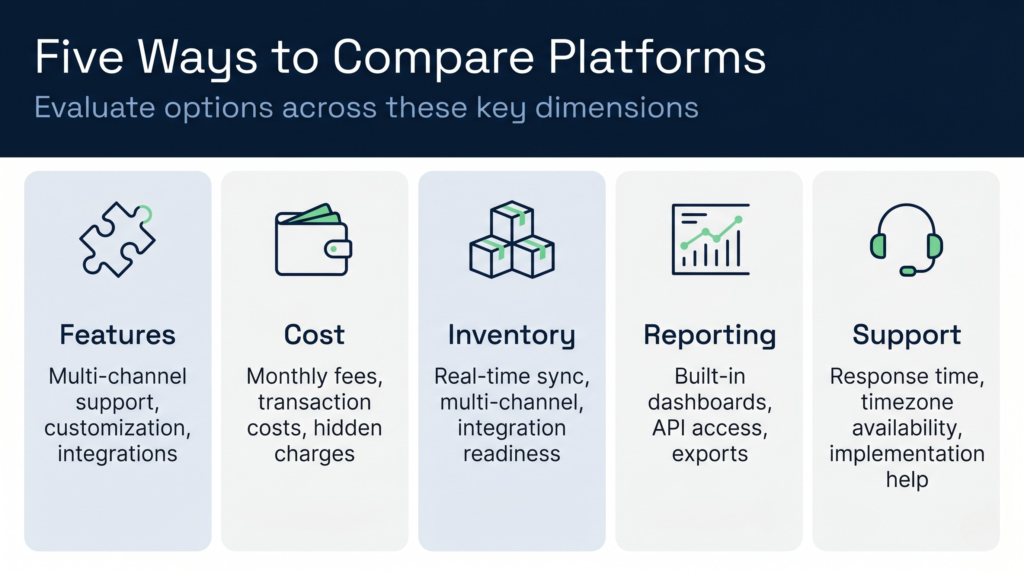
When you’re evaluating options, compare platforms across these dimensions:
Features and Flexibility
Does the platform support the product types you sell (digital, physical, subscriptions)? Can you integrate with third-party tools like email marketing, analytics, or accounting software? Some providers lock you into their ecosystem; others embrace open APIs and integrations. Check whether you can customise the look and feel to match your brand or if you’re forced into a template.
Cost Structure
Understand the full cost picture. Some platforms charge a flat monthly fee plus a percentage of sales. Others charge a transaction fee. Don’t forget add-ons like SSL certificates, payment gateway fees, and premium features. Bluepark and ePOS Direct both offer UK-focused solutions with transparent pricing models, though what works best depends on your transaction volume and margins.
Inventory and Order Management
This is where many solutions fall short. Can your platform sync inventory across multiple sales channels (your website, marketplace, physical stores) in real-time? If you oversell because your system doesn’t sync fast enough, you’ll damage customer trust and incur return costs. A robust ecommerce solution provider integrates tightly with your inventory and warehouse systems. If you’re using a 3PL partner, check whether your platform connects directly to their warehouse management system to avoid manual order entry.
Reporting and Analytics
You need visibility into sales trends, customer behaviour, conversion rates, and margins. Some platforms offer basic dashboards; others provide deep analytics APIs so you can build custom reports. The ability to export data to tools like Excel or Google Sheets matters too, especially if you work with accountants or analysts outside your team.
Support and Implementation
How long does it take to go live? Will the provider help you migrate existing data? What support do you get? Look at response times, available languages, and whether support is available during your business hours. For ecommerce solutions UK businesses use, support during UK business hours is essential.
Ecommerce Specialists and Implementation Support
Picking a platform is one thing. Implementing it properly is another. Many providers offer implementation services, either included or as add-ons. This matters especially for complex setups.
If you’re migrating from an old system, you need help moving customer data, product information, and order history without losing anything or damaging SEO. If you’re setting up multi-channel selling (website, marketplace, physical store), you need expertise in syncing inventory and orders across channels.
For goods receiving and warehouse operations, integration becomes critical. Your ecommerce platform should feed purchase orders to your warehouse, which picks and packs based on sales channel and then confirms shipment back to the platform. Mistakes here are costly. A wrong item shipped costs you a return, refund, and lost customer goodwill.
Implementation specialists can also help with choosing the right warehouse management system to pair with your ecommerce platform. Some combinations work better than others. A specialist will evaluate your volume, product mix, and growth plans to recommend the best fit.
Custom Ecommerce Solutions and When You Need Them
Off-the-shelf platforms work well for many businesses, but sometimes custom ecommerce solutions are worth the investment.
You might need a custom solution if:
- Your business model is unusual. If you sell subscriptions, marketplace items, or require complex approval workflows, standard platforms might not fit.
- You have existing systems that must integrate. If you run a large ERP or accounting system with unique workflows, building custom integrations or a custom platform might be cheaper than trying to force-fit a standard solution.
- Scale and performance matter. Massive transaction volumes or complex real-time reporting requirements might demand custom architecture tuned to your specific needs.
- You need white-label options. If you’re reselling or operating under a partner model, a white-label custom solution lets you control the entire experience.
Custom solutions cost more and take longer to build, but they’re built for you, not for a generic customer. When you integrate a custom ecommerce solution with purpose-built warehouse software, you eliminate friction between sales and fulfillment.
Integration with Warehouse and Fulfillment Systems
Here’s where the real value emerges. An ecommerce solution provider is only as good as its ability to talk to the rest of your business.
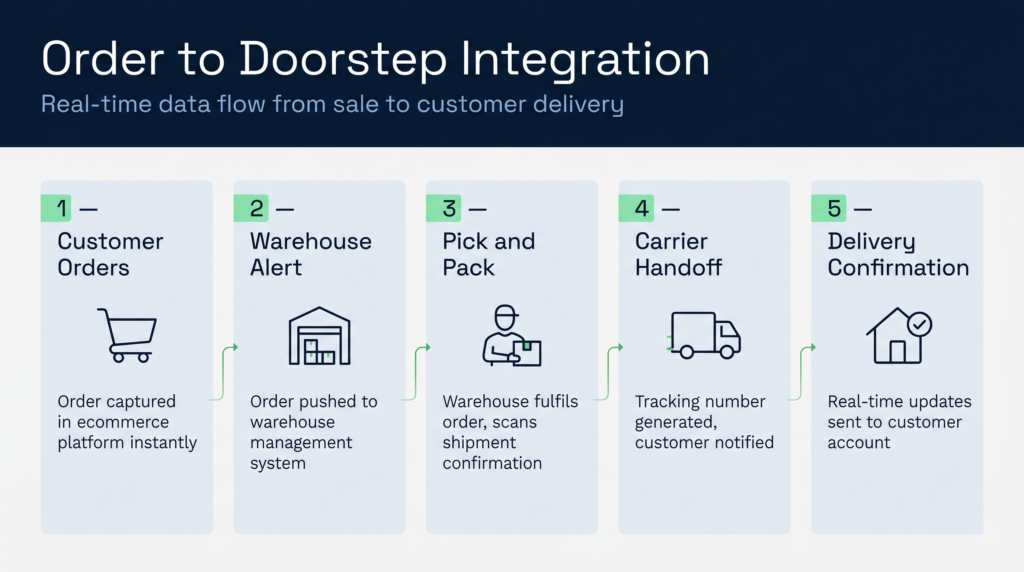
When a customer orders through your ecommerce platform, the system must instantly notify your warehouse. If you use a 3PL, that means pushing the order to their warehouse management system with all the detail needed: what was ordered, where it should ship, any special handling requirements, and the customer’s delivery preferences. When the warehouse picks and packs, the system updates. When the carrier scans the package, tracking updates appear in your customer’s account in real-time.
This integration isn’t just convenient; it’s competitive. Fast shipping updates keep customers informed. Accurate picking reduces returns. Automated invoicing saves your finance team hours of work. When your ecommerce platform and warehouse system speak fluently, you reduce errors and get orders to customers faster.
For ecommerce businesses using 3PL partners, this becomes essential. Your 3PL needs real-time visibility into incoming orders. You need real-time visibility into stock levels and fulfillment status. When this works smoothly, both sides win. You focus on selling and marketing; your 3PL focuses on accurate, fast fulfillment.
Ecommerce Solutions UK Market Considerations
Choosing an ecommerce solution UK businesses trust means considering local factors:
Currency and tax handling matter. UK businesses need to calculate VAT correctly and potentially handle taxes for EU sales or international orders. Some platforms handle this well; others require manual configuration or custom development.
Delivery expectations in the UK are shaped by Amazon. Customers expect 1-2 day delivery as standard, especially in major cities. Your ecommerce platform must integrate with your logistics to fulfil these expectations. Teaming up with an efficient 3PL and using a platform that integrates directly with their warehouse systems helps you meet or beat these timelines.
Data protection and GDPR compliance are non-negotiable. Your provider must be certified and transparent about where data is hosted and how it’s protected. GDPR breaches aren’t just fines; they damage customer trust.
Support in your timezone is crucial. If you have questions at 2pm on a Tuesday and your provider’s support is based 8 time zones away, you’ll wait overnight for answers. Look for providers with UK or European support teams.
Calculating the Real Cost of Warehousing and Fulfillment
Your ecommerce solution provider choice affects not just platform costs but also the entire cost of operations. An integration with a responsive, accurate 3PL can save you money through efficiency gains that far exceed software costs.
Returns handling is a good example. When your ecommerce platform integrates seamlessly with your warehouse, returns are processed faster. Damaged stock is identified quickly. Restocking is efficient. All this drives down the per-unit cost of handling returns. If returns represent 20% of your sales and your cost per return is £5, even cutting that to £4 through efficiency gains saves thousands per year.
Clarus WMS: Bridging the Gap Between Click and Delivery
Choosing the right front-end ecommerce platform is only half the battle; long-term success depends on how quickly and accurately that platform talks to your warehouse. This is where Clarus WMS completes the loop.
As a cloud-native warehouse management system, Clarus integrates directly with over 200 channels—including leading platforms like Shopify, Magento, and WooCommerce, alongside major global marketplaces. The moment a customer checks out, the order is instantly pushed to the warehouse floor for optimised picking and packing.
By syncing physical inventory levels back to your online store in real-time, Clarus eliminates the risk of costly oversells. Once dispatched, tracking data is automatically pushed back to the customer. Pairing your ecommerce solution with Clarus WMS removes manual friction, slashes picking errors, and ensures your backend can scale just as fast as your online sales.