

If you run a third party logistics operation, you know that managing multiple client warehouses, inventory, and shipments is a completely different challenge from traditional warehouse management. Standard WMS solutions aren’t built for this complexity, which is why choosing the right 3PL software provider matters so much.
The best 3PL software providers offer purpose-built solutions that handle multi-tenant operations, sophisticated billing, and integrated customer portals. Whether you’re evaluating a 3PL WMS software system, comparing 3PL warehouse management systems, or exploring third party logistics software options, this guide will help you understand what to look for in a provider and how to evaluate your options effectively.
What is a 3PL Software Provider?
A 3PL software provider delivers warehouse management systems specifically designed for third-party logistics companies. Unlike generic warehouse software, 3PL WMS platforms handle the unique demands of managing multiple customer accounts within a single facility.
Think of it this way: a traditional WMS manages one company’s inventory in one warehouse. A specialized solution like Clarus WMS manages dozens of different companies’ inventory in the same physical space, ensuring complete separation of data, accurate client billing, and distinct performance metrics for each individual customer.

Core responsibilities of 3PL software providers
- Multi-tenant architecture: Isolate inventory, orders, and data for each customer within a unified platform, ensuring complete privacy and preventing cross-contamination.
- Billing and invoicing: Automate complex billing models including storage fees, pick and pack charges, handling costs, and SKU management fees based on individual client contracts.
- Customer portal: Give your clients real-time visibility into their inventory, orders, and shipments through a dedicated portal without exposing your operational backend.
- Regulatory compliance: Support GDPR, data protection, and industry-specific regulations that matter when you’re handling other companies’ critical business assets.
What Software Do 3PL Companies Use?
Most 3PL companies use a combination of tools working together. The core system is typically a dedicated 3PL WMS, but it doesn’t work in isolation. You’ll find integrations with carrier management software, Transport Management Systems (TMS) like Qargo, inventory forecasting tools, and accounting platforms.
Leading 3PL software providers ensure their solutions work seamlessly with the wider ecosystem. This is why WMS integrations matter so much. Your software needs to connect with your existing tools without manual workarounds or custom development.
The typical tech stack for 3PL operations
- Warehouse Management System (WMS): The core platform handling inventory, orders, picking, and packing.
- Transportation Management System (TMS): Manages carrier selection, shipment tracking, and shipping cost optimisation.
- Accounting software: Integrates invoicing, revenue recognition, and financial reporting specific to your 3PL model.
- Customer communication tools: Email, SMS, and API integrations for notifying clients of order status and inventory levels.
How Does 3PL Software Differ from Standard WMS?
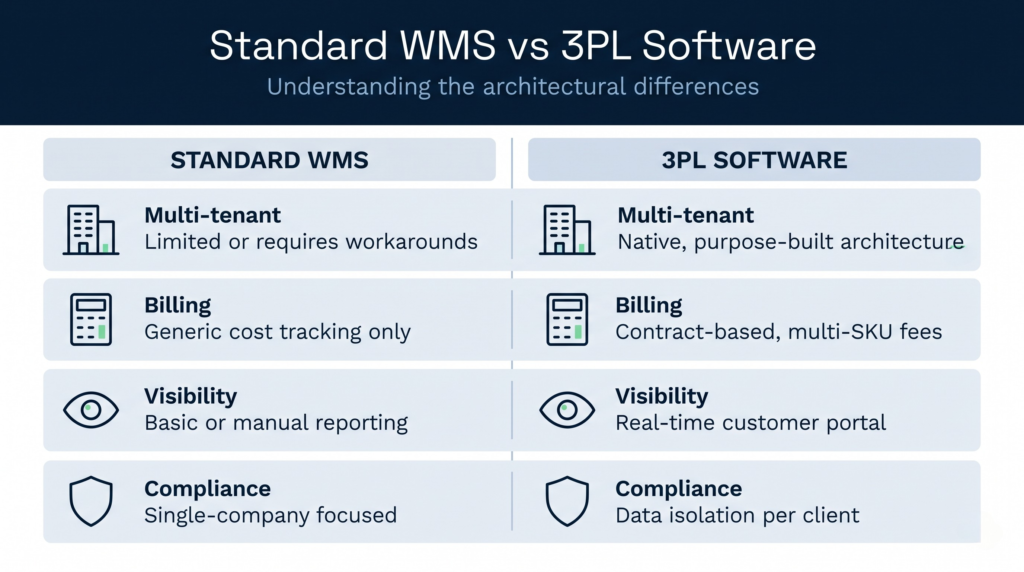
This is the critical distinction many companies miss. A standard WMS isn’t broken, but it’s built with single-company warehousing in mind. When you try to force a generic system to handle 3PL operations, you run into fundamental architectural problems.
Key differences in functionality
| Feature | Standard WMS | 3PL Software Provider |
| Multi-tenant support | Limited or requires workarounds | Native, purpose-built architecture |
| Automated billing | Generic cost tracking only | Contract-based, multi-SKU fee structures |
| Customer visibility | Basic or manual reporting | Real-time portal with granular permissions |
| Compliance isolation | Single-company focused | Data isolation and audit trails per client |
| Scalability | Performance degrades with multiple clients | Built to handle growth without losing speed |
A standard WMS tracks inventory by SKU and location. A 3PL WMS tracks inventory by SKU, location, and customer simultaneously. That single change cascades through the entire system’s architecture, affecting how it handles pricing, reporting, and customer access.
What Features Should a 3PL Software Provider Offer?
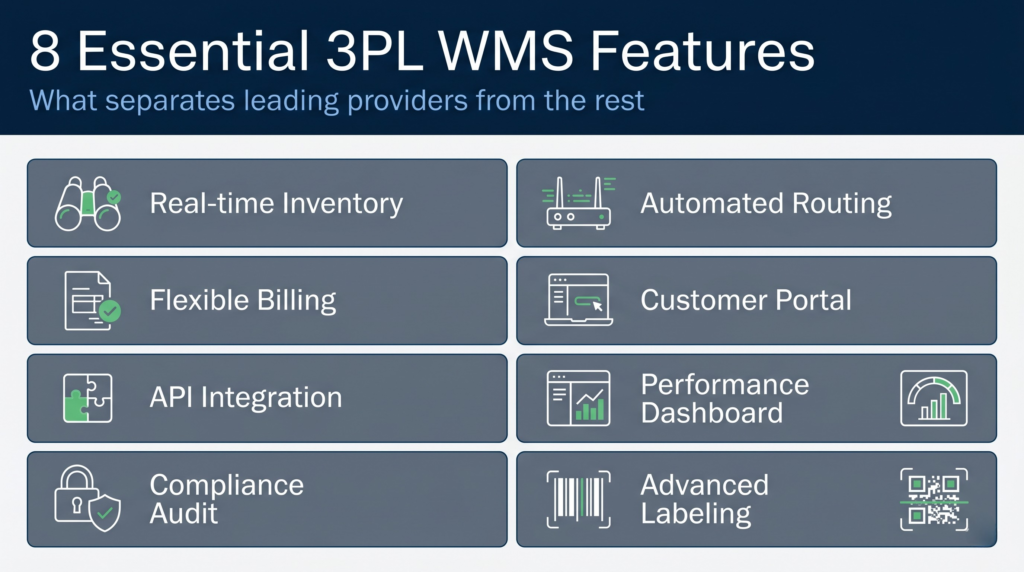
When evaluating 3PL software providers, look beyond marketing claims. Test whether each platform actually solves real 3PL problems. Here are the must-have features.
Essential features for 3PL operations
- Real-time inventory visibility: Each customer sees only their stock, updated instantly as orders process and goods move through your facility.
- Automated order routing: Direct customer orders to the correct location and pick zone without manual intervention, saving time and reducing errors.
- Flexible billing models: Support per-pallet storage, per-pick fees, minimum monthly charges, SKU management, and custom billing rules unique to each client contract.
- Customer self-service portal: Let clients check inventory, download reports, track shipments, and manage their account settings without calling your team.
- Integration-ready API: Connect seamlessly with your customer’s e-commerce platform, accounting software, or supply chain systems using documented APIs.
- Performance dashboards: Give your operations team visibility into KPIs like pick accuracy, order cycle time, and utilisation rates across all customers.
- Compliance and audit trails: Maintain detailed logs of all transactions, user actions, and data changes for regulatory requirements and dispute resolution.
- Scalable labelling and tracking: Handle multi-format barcodes, batch labelling, and carton tracking as your operation grows.
How to Choose a 3PL WMS Provider
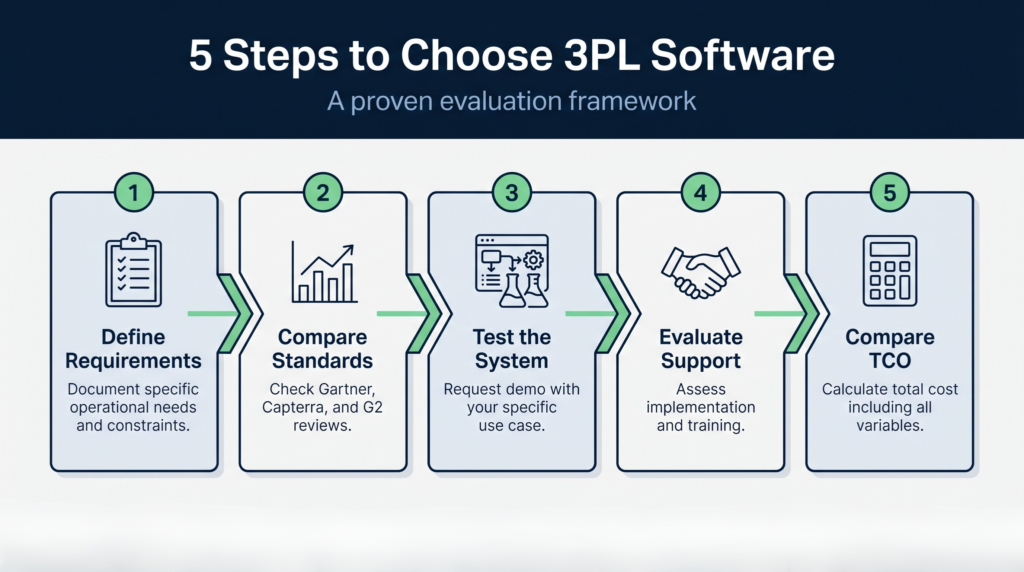
Choosing the wrong 3PL software provider can cost thousands in extra labour, lost efficiency, and unhappy customers. Here’s a framework for evaluating your options.
Step 1: Define your specific requirements
Before talking to vendors, document your operational needs. How many customers do you service? What’s your peak throughput? Do you need multi-site support? What’s your current warehouse costs breakdown, and how can software reduce it?
This clarity prevents you from being swayed by flashy features you don’t need and ensures vendors understand your real constraints.
Step 2: Compare against industry standards
Check platforms reviewed on Gartner WMS Reviews, Capterra, and G2 WMS Category listings. These platforms aggregate vendor reviews and provide scoring systems across hundreds of implementations.
Read reviews from other 3PL operators to learn about real-world implementation experiences. Industry organisations like the UK Warehousing Association and the Chartered Institute of Logistics and Transport often provide guidance on vendor selection and may highlight leading platforms.
Look specifically for 3PL case studies. A vendor with strong retail WMS credentials might struggle with 3PL complexity.
Step 3: Test the actual system
Request a demo that includes your specific use case. Ask them to show:
- How they’d set up a new customer account
- How billing rules would be configured for a complex contract
- What the customer portal looks like and how clients access reports
- Performance under peak load with multiple concurrent users
- How WMS integrations work with your existing systems
Step 4: Evaluate implementation support
Implementation timelines matter. A system that takes six months to go live costs you in consultant fees, extended training, and delayed customer onboarding. Ask about:
- Typical implementation duration for a company your size
- Available resources during your go-live (dedicated team or shared support)
- Training provided for your staff and customer-facing teams
- Post-launch support model and response times
Step 5: Compare total cost of ownership
WMS pricing models vary dramatically. Some charge per transaction, others per customer, and some use hybrid models. Look beyond the per-user fee and calculate what you’ll actually pay once you add customers, transaction volume, and support hours.
Factor in the hidden costs too: integration development, staff training, and the consultant time needed to configure complex billing rules.
What is the Best 3PL Software in the UK?
There’s no single “best” because your ideal solution depends on your specific operation. However, the best 3PL software providers share common traits.
Characteristics of leading 3PL software providers
- Purpose-built for 3PL: Not a generic WMS with 3PL bolted on, but a system architected from the ground up for multi-tenant operations.
- Proven track record: Long history working with established 3PL companies, not just new startups testing their platform.
- UK market knowledge: Understanding of local regulations, typical 3PL business models, and the UK logistics community through organisations like the UK Warehousing Association.
- Regular updates and innovation: Active development roadmap that evolves with industry demands, not stagnant software from five years ago.
- Customer support that understands 3PL: Support team familiar with the nuances of multi-client operations, not reading from a generic support script.
For many growing 3PL companies in the UK, Clarus WMS stands out because it’s genuinely designed for this market. It handles the core 3PL challenges—multi-customer billing, customer portals, and complex inventory management—without forcing workarounds.
If you’re evaluating a 3PL WMS provider, make sure you understand what is a warehouse management system and the specific requirements for 3PL operations. This knowledge shapes better vendor questions and clearer evaluation criteria.
Understanding 3PL WMS Software and Distribution
Many 3PL companies also handle distribution for their customers. This requires a system that can manage both storage and outbound picking at scale. The best 3PL software providers offer integrated distribution WMS capabilities, handling everything from receiving and putaway through to pick, pack, and ship.
This integrated approach means your team uses one system instead of juggling separate tools for storage operations and distribution picking. It also means your customers get unified visibility across their entire supply chain within a single portal.