

If you run a third-party logistics operation, you already know that a standard warehouse management system won’t cut it. A 3PL WMS — warehouse management software designed specifically for third-party logistics providers — handles the multi-client complexity, billing automation, and client-facing visibility that generic platforms simply weren’t built for. This guide covers everything you need to know: what makes a 3PL WMS different, how to choose the right one for 3PL, and why the platform you pick will define how efficiently you can scale.
What is 3PL in WMS?
The term “3PL” stands for third-party logistics. A 3PL business takes on warehousing, fulfilment, and distribution on behalf of other companies. Unlike a retailer or manufacturer running a single-client warehouse, a 3PL juggles multiple clients under one roof — often with entirely different product types, SLAs, and order management workflows.
A 3PL WMS is warehouse management software engineered around that reality. It provides client-level stock segregation, per-client billing rules, and separate reporting portals — features that standard WMS software doesn’t offer out of the box. To understand the foundations first, it helps to read up on what a warehouse management system does at its core: tracking stock movements, directing picking, and integrating with sales channels. A 3PL WMS does all of that, then layers on the multi-tenancy logic that makes running several clients from one warehouse operationally viable.
In short, a 3PL WMS treats each client as its own virtual warehouse within your physical building. That separation matters enormously for compliance, billing accuracy, and the client relationships you depend on for recurring revenue.
What Does a 3PL WMS Need to Do Differently from a Standard WMS?
This is the question most operations directors ask when they first evaluate platforms. The gap between a standard WMS and a purpose-built 3PL WMS system is wider than most expect.
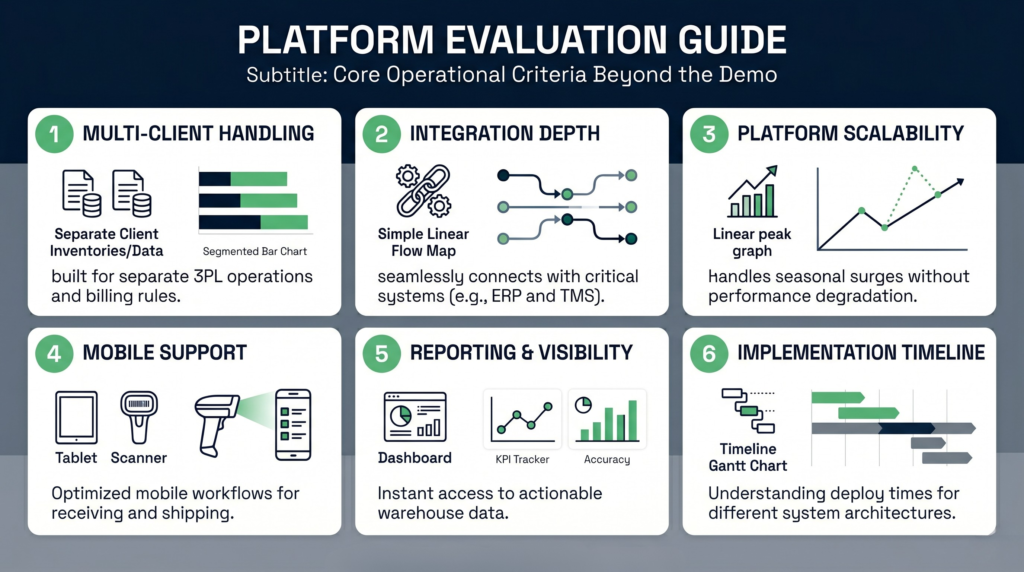
Multi-client stock segregation
In a single-client warehouse, every SKU belongs to the same business. In a 3PL, Client A’s stock must never bleed into Client B’s pick face, reporting, or invoicing — even if they share the same physical location or racking bay. A proper 3PL WMS enforces this at the data layer, not just through physical location rules. Each client gets its own inventory ledger, its own order queue, and its own stock valuation.
Automated client billing
Billing is where many 3PLs lose margin. If your team manually tallies storage fees, pick charges, inbound handling, and special project costs at month-end, errors creep in and disputes follow. A 3PL WMS system captures every billable event as it happens — a pallet booked in, a pick completed, a label printed — and aggregates those events into an invoice automatically. This alone can save a mid-sized 3PL dozens of hours per month and dramatically reduce billing disputes with clients.
Client portals and real-time visibility
Your clients want to see their stock levels, order statuses, and despatch confirmations without calling your office. A 3PL WMS provides self-service portals so clients can log in, check inventory, download reports, and raise queries independently. This cuts inbound enquiries and gives clients the transparency they increasingly expect — particularly ecommerce brands who monitor their stock constantly.
Flexible per-client service configuration
One client ships next-day courier; another ships weekly pallets to retailers. One requires barcode scanning at goods-in; another needs serial number capture at despatch. A 3PL WMS lets you configure these rules individually per client without creating separate system instances or messy workarounds. That flexibility allows a single 3PL operation to serve five very different clients cleanly from one platform.
Some platforms do offer multi-client functionality, but operators often find they need significant customisation to handle real-world edge cases — particularly around billing logic and bespoke SLA configurations. A purpose-built 3PL platform has that logic already baked in from day one.
3PL vs 4PL: What’s the Difference?
The 3PL vs 4PL distinction comes up frequently, and it’s worth clarifying because it affects what software you actually need.
A 3PL (third-party logistics provider) physically handles warehousing and fulfilment. You store goods, pick orders, and despatch them — you own the warehouse operations. A 4PL (fourth-party logistics provider), by contrast, manages the supply chain on behalf of a client without necessarily operating physical infrastructure. A 4PL might coordinate multiple 3PLs, freight carriers, and customs agents as a single orchestrating layer.
If you’re a 3PL, you need a WMS that controls physical inventory and warehouse operations. If you operate as a 4PL — or you’re a 3PL expanding into 4PL services — you may also need a transport management system and supply chain visibility tools on top. For most UK 3PLs, the WMS is the operational core, and everything else integrates around it.
The UK Warehousing Association’s industry growth report highlights sustained demand for outsourced logistics services across the UK. That means the number of 3PL operators competing for clients is rising, and operational efficiency — driven by the right WMS software — is increasingly how 3PLs differentiate on service rather than price alone.
What WMS Does DHL Use?
DHL uses enterprise-grade platforms including SAP Extended Warehouse Management (SAP EWM) across many of its global operations. At that scale, enterprise software makes sense: DHL has the IT teams, budget, and implementation timelines to support them.
But the reality for most UK 3PLs is very different. You’re not DHL. You likely run between one and ten warehouse sites, serve a handful to a few dozen clients, and need software you can implement in weeks — not 18 months — that your team can use without extensive training. The enterprise platforms DHL deploys carry six-figure implementation costs and ongoing consulting overhead that most independent 3PLs can’t justify or absorb.
This is why purpose-built 3PL WMS solutions designed for the UK mid-market are growing in adoption. Access Group’s WMS targets this space, as does Mintsoft. However, platforms that position 3PL as one vertical among many can show their limitations when operators push into complex billing scenarios or need granular per-client SLA management. OrderFlow and Canary7 also appear in this space, though they tend to suit simpler, ecommerce-heavy workflows more than complex multi-client 3PL operations with diverse service tiers. Optima covers broader supply chain needs but isn’t laser-focused on 3PL warehouse operations specifically.
A platform built from the ground up for 3PL — rather than adapted from a general warehouse system — handles the edge cases that cause real operational problems: split billing across service lines, client-specific put-away strategies, and mixed-service configurations across a shared workforce.
How to Choose a WMS for 3PL
Choosing the right 3PL warehouse management system is one of the most consequential technology decisions you’ll make. Get it wrong and you’ll spend years working around a platform that wasn’t designed for your operation. Get it right and your WMS becomes a genuine competitive advantage — letting you onboard new clients faster, charge more accurately, and scale without hiring proportionally.
Here are the key criteria to evaluate. For a comprehensive framework, the How to Choose a WMS guide walks through each factor in detail, including how to run a proper vendor comparison.
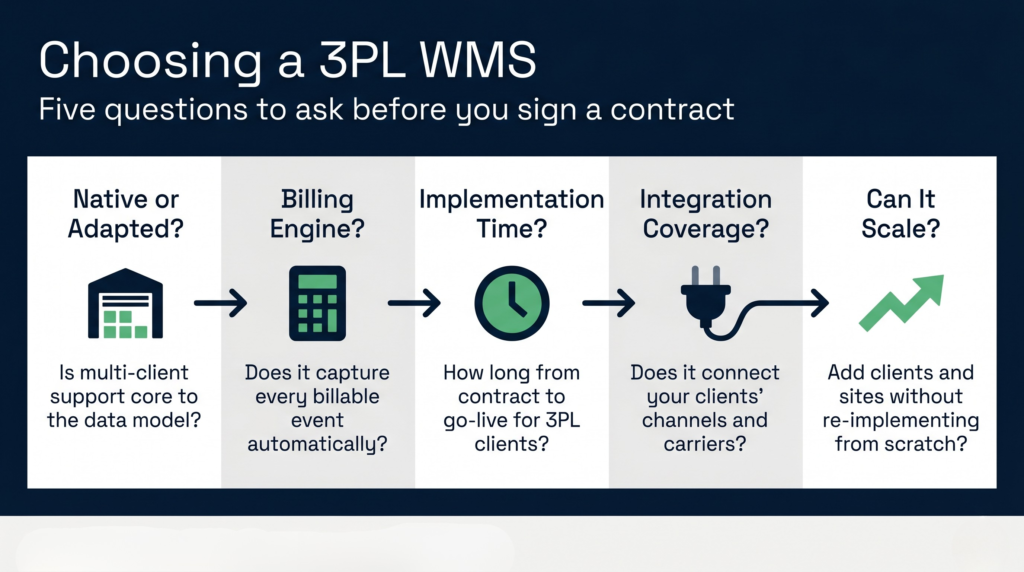
Is it genuinely built for 3PL, or adapted?
Ask vendors directly: was multi-client support built into the core data model from day one, or added later as a module? Adapted platforms often show their seams under pressure — billing logic that requires spreadsheet workarounds, reporting that conflates client stock, or portals that need custom development to function properly. A native 3PL WMS architecture treats multi-tenancy as fundamental, not optional.
How does the billing engine work?
Request a live demo of the billing module. Can it capture storage by pallet position, picks by line, handling charges by weight, and ad-hoc special projects — all per client, all automatically? Can it generate a draft invoice you review before sending? If the answer involves spreadsheets or manual exports at any point in the process, that’s a significant operational risk.
What does implementation look like?
A good WMS implementation for a 3PL should have a clear go-live timeline, a structured data migration process, and a team that understands 3PL-specific configuration — not just generic warehouse setup. Ask for references from 3PL clients specifically, and ask how long their implementations took from contract to go-live.
How does it handle integrations?
Your clients will connect their own ecommerce platforms, ERPs, and carrier accounts. Your 3PL WMS needs to support a wide range of integrations without requiring bespoke development for every new client. Look for pre-built connectors to Shopify, WooCommerce, Amazon, and the major UK carriers, plus an API that makes custom integrations feasible without large development fees.
Can it scale with you?
Today you might have six clients. In three years you might have twenty, across two sites. Your WMS for 3PL should scale at the subscription level — adding clients, users, and locations — without requiring a platform migration or a re-implementation. Cloud-native platforms handle this far better than on-premise or heavily customised legacy systems.
Key Features of a Purpose-Built 3PL WMS
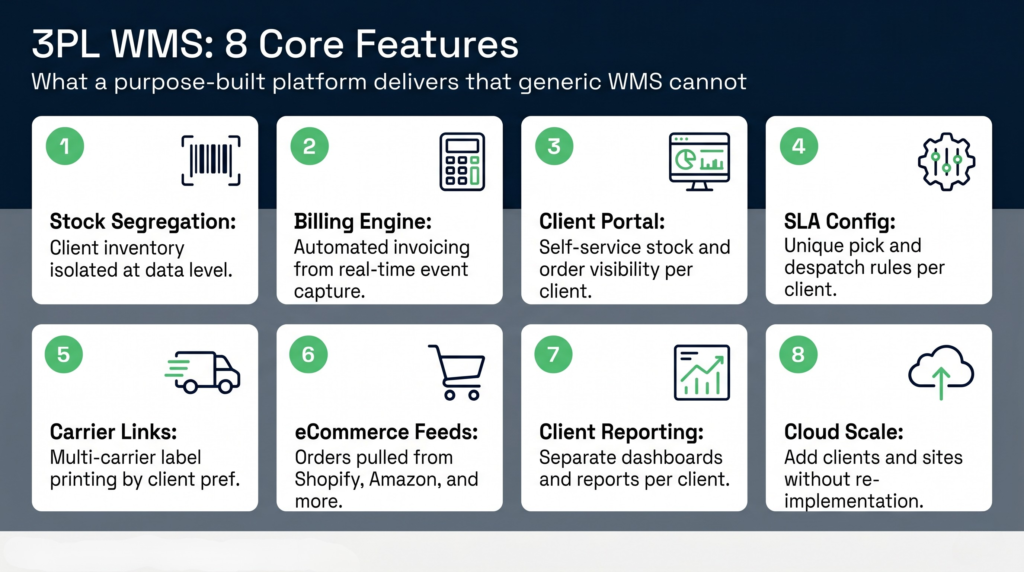
Not all 3PL WMS software covers the same ground. These are the features that separate a genuinely purpose-built platform from one that’s been retrofitted for 3PL use.
| Feature | Why It Matters for 3PL |
|---|---|
| Multi-client stock segregation | Keeps each client’s inventory completely isolated in data and reporting |
| Automated billing engine | Captures every billable event in real time, eliminating manual invoice work |
| Client self-service portal | Reduces inbound queries and gives clients real-time stock and order visibility |
| Per-client SLA configuration | Different pick, pack, and despatch rules per client without system workarounds |
| Carrier integration | Print labels and book collections across multiple carriers per client preference |
| eCommerce channel connectors | Pull orders automatically from Shopify, Amazon, WooCommerce, and others |
| Real-time reporting by client | Separate dashboards and reports for each client, not combined views |
| Scalable cloud architecture | Add clients and sites without re-implementation or costly upgrades |
Good inventory and warehouse management sits at the core of all of these features. Without accurate real-time inventory data at the client level, billing, reporting, and client portals all become unreliable — and unreliable systems erode client trust quickly.
Why UK 3PLs Need a 3PL-Native Platform
The UK third-party logistics market is one of the most competitive in Europe. Clients expect high service levels, transparent reporting, and competitive pricing — and they’ll switch providers if they don’t get them. That pressure pushes 3PL operators to run leaner, onboard faster, and deliver more value per client pound.
A 3PL management system purpose-built for this environment gives you structural advantages that generic warehouse software can’t replicate. When your billing runs automatically, your operations team focuses on fulfilment rather than finance admin. When clients have their own portal, your account managers field fewer status calls. When onboarding a new client takes days rather than weeks, you can win and service more contracts without scaling headcount proportionally.
The 3PL WMS market is evolving rapidly, with more operators recognising that their WMS is a client retention tool as much as an operational one. Clients who can see their stock, trust their invoices, and integrate their sales channels seamlessly are far less likely to move to a competitor — even if a competitor quotes a lower storage rate.
Clarus WMS was built specifically for UK 3PL operators. The billing engine, client portals, multi-client stock architecture, and carrier integrations were designed with 3PL operations in mind from the ground up — not added as optional extras to a general warehouse platform. Implementations typically complete in weeks, and the platform scales as your client base grows without requiring a re-implementation or a second system.