

Running an online retail operation without an e-commerce management system is a bit like managing a busy kitchen without a ticket system. Orders come in, staff scramble to keep up, and mistakes are inevitable. An e-commerce management system brings order to that chaos. It connects your sales channels to your inventory, your inventory to your warehouse, and your warehouse to your customers. This guide covers what these systems do, why warehouses and 3PLs can’t afford to operate without one, and what to look for when choosing the right solution for your business.
What is an e-commerce management system?
An e-commerce management system is software that centralises the core operational functions of an online retail business. It typically handles order management, inventory visibility, customer data, shipping coordination, and channel integration from a single platform.
Think of it as the nerve centre of your online operation. When a customer places an order on your website, the system logs it, checks stock availability, routes it to the correct fulfilment location, and triggers the despatch process. Without this central layer, each of those steps happens in isolation, relying on spreadsheets, manual checks, or disconnected point solutions.
The term is used broadly. Some vendors use it interchangeably with ecommerce management software, while others position it as a suite that encompasses an order management system (OMS), a product information management tool, and basic inventory tracking. In practice, the scope depends on the vendor and the size of the business.
Platforms like Shopify, Magento, WooCommerce, and BigCommerce all offer front-end storefront tools with varying degrees of back-end management capability. But for businesses handling significant fulfilment volumes, those built-in tools often reach their limits quickly.
What features should an e-commerce management system have?
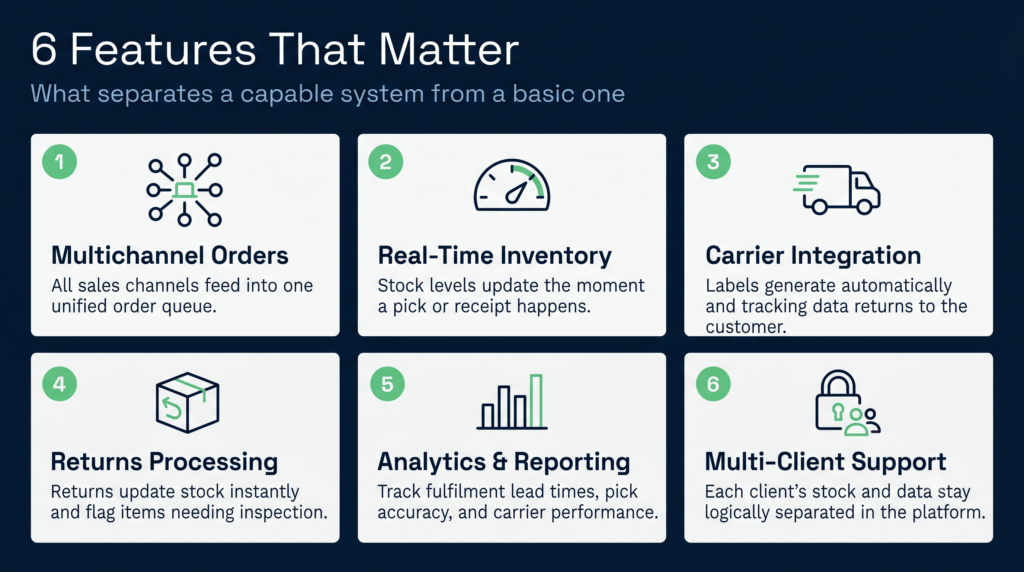
Not all systems are equal. The right one for a small DTC brand looks very different from what a 3PL handling 50 online retail clients needs. That said, several core features separate a capable system from a basic one.
Multichannel order management
If you sell across Amazon, your own website, and a wholesale portal, orders should flow into one place. A solid order management system consolidates those channels, prevents overselling, and gives your team a single queue to work from. Tools like Linnworks are built specifically for multichannel sellers who need exactly this kind of centralised order routing.
Real-time inventory visibility
Stock levels must update the moment a pick happens, a return arrives, or a new delivery lands. Delayed inventory data causes overselling, customer complaints, and write-offs. Real-time visibility across all sales channels and fulfilment locations is non-negotiable for any business moving meaningful volume.
This is closely tied to how efficiently your team manages the goods-in process. If receipts aren’t captured accurately at the point of arrival, every downstream inventory figure is unreliable.
Shipping and carrier integration
The system should connect to your preferred carriers, generate labels automatically, and pass tracking data back to the customer. Manual label printing from a separate portal is slow and error-prone at scale.
Returns management
Returns are a core part of e-commerce, especially in fashion and consumer electronics. A good system tracks return reasons, updates stock levels on receipt, and flags items that need inspection or disposal. Ignoring returns management creates inventory inaccuracies that compound over time.
Reporting and analytics
You need visibility into order volume trends, fulfilment lead times, pick accuracy rates, and carrier performance. Systems that only give you transactional data without analytical context leave you flying blind on operational decisions.
What is the difference between an OMS and a WMS?
This is one of the most common questions in this space, and the confusion is understandable. Both systems play a role in the order fulfilment journey, but they operate at different layers.
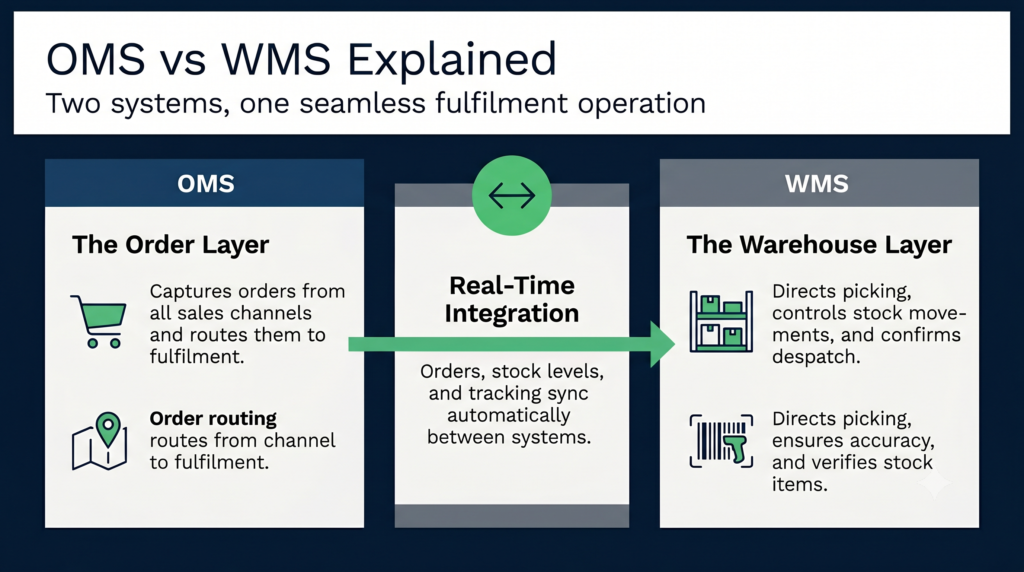
An order management system handles the commercial side: capturing orders from sales channels, managing customer records, routing orders to fulfilment locations, and tracking despatch status. It sits between the storefront and the warehouse.
A warehouse management system handles the physical side: directing warehouse staff to pick locations, managing put-away logic, controlling stock movements, and optimising space utilisation. It operates inside the four walls of the warehouse.
In short: the OMS decides which warehouse should fulfil an order. The WMS tells the team inside that warehouse exactly how to do it.
| Feature | Order Management System (OMS) | Warehouse Management System (WMS) |
|---|---|---|
| Primary focus | Order routing and customer fulfilment | Warehouse operations and stock control |
| Where it lives | Between storefront and warehouse | Inside the warehouse |
| Users | Customer service, ops managers | Warehouse operatives, site managers |
| Key outputs | Despatch notifications, order status | Pick lists, put-away instructions, stock reports |
| Inventory management | High-level, cross-channel | Granular, location-level |
For a business operating at scale, you need both. The OMS handles the commercial layer; the WMS handles the operational one. They need to talk to each other seamlessly.
How does an e-commerce management system work with a WMS?
The integration between an e-commerce management system and a WMS is where fulfilment operations either flow smoothly or fall apart. When they’re properly connected, an order placed at midnight on a customer’s phone triggers a chain of automated events: the OMS receives and validates the order, passes it to the WMS with all line-item detail, the WMS generates a pick task, the picker scans the items, and despatch confirmation flows back to the OMS and then to the customer.
When they’re not connected, someone is copying orders between systems, manually updating stock, and hoping nothing falls through the gap. That approach collapses under volume.
The quality of the connection matters as much as having one. Batch syncs that run hourly create inventory lag. Real-time, bidirectional integrations with e-commerce platforms via API are the standard to aim for. They ensure stock levels, order status, and tracking data all stay current across every system in your stack.
Inventory management for ecommerce depends on this integration. If your WMS doesn’t push stock updates to your storefront in real time, you’ll sell inventory you don’t have. That means cancellations, refunds, and damaged trust with customers who don’t give second chances.
Why warehouses and 3PLs need a dedicated system
For a small brand shipping 20 orders a day, a basic Shopify back-end and a good spreadsheet might just about work. For a warehouse handling thousands of lines daily, or a 3PL serving multiple e-commerce clients, that approach is unworkable.
Warehouses need a purpose-built system because:
- Volume demands automation: Manual processes don’t scale. Pick lists, label generation, and stock reconciliation must happen automatically to keep pace with order volumes.
- Accuracy is critical: A 1% error rate sounds small until you’re processing 10,000 orders a week. At that point, 100 customers per week receive the wrong item, and your returns volume and customer service costs spiral.
- Space optimisation matters: A WMS with strong put-away logic reduces unnecessary travel in the warehouse. Without it, pickers walk further, spend more time, and pick fewer orders per hour.
- Stock integrity drives everything: Overselling, write-offs, and phantom stock all trace back to poor stock control. A proper system eliminates these by maintaining accurate, real-time counts at location level.
How do 3PLs manage multiple e-commerce clients?
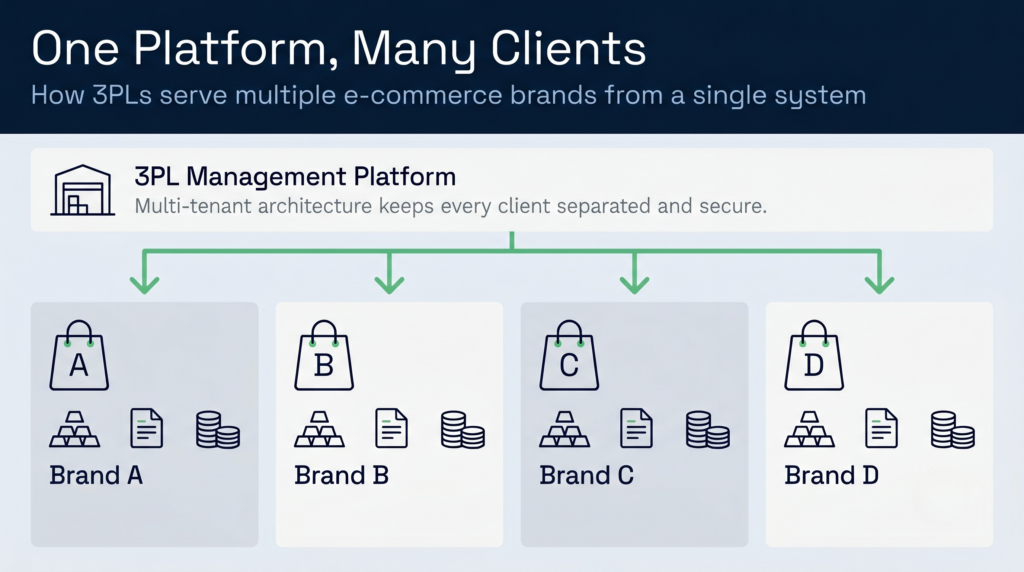
For third-party logistics providers, the challenge is an order of magnitude greater than a single-brand operation. A 3PL might handle fulfilment for 10, 20, or 50 different e-commerce brands simultaneously. Each client has its own SKU list, its own sales channels, its own SLA requirements, and its own billing structure.
Generic ecommerce management software isn’t built for this complexity. What 3PLs actually need is a WMS with native multi-client architecture, automated billing, and client-facing reporting. That’s a specific capability set that most standard platforms simply don’t offer.
With the right 3PL management system, each client operates in a logically separated environment within the same platform. Stock doesn’t cross-contaminate. Billing calculates automatically based on agreed rate cards. And clients can access their own reporting portal without requiring warehouse staff to produce manual reports.
Without that, 3PLs typically end up managing client separation through workarounds: separate spreadsheets, colour-coded racking, and lots of manual checking. As the client roster grows, so does the operational risk.
How to integrate e-commerce platforms with warehouse software
Integration sounds technical, but the decision framework is straightforward. You need to answer three questions: which platforms do you need to connect, what data needs to flow between them, and how often does it need to update.
Which platforms to connect
Most e-commerce operations run on one of a handful of platforms: Shopify, WooCommerce, Magento, BigCommerce, or a marketplace like Amazon or eBay. Your WMS needs certified, maintained integrations with each platform you sell on. Pre-built connectors are faster and more reliable than custom API work built from scratch.
What data needs to flow
At minimum, you need bidirectional sync of orders (inbound to WMS), stock levels (outbound to storefront), and despatch confirmation with tracking data (back to the OMS and customer). Some integrations also handle product data, return notifications, and B2B order routing.
Update frequency
Real-time is the goal. Hourly batch syncs create windows where you can oversell. For high-volume operations, even a 15-minute lag is too long. Make sure your chosen system uses webhooks or live API calls rather than scheduled batch processes.
Knowing how to choose the right system comes down to matching these integration requirements against what each vendor actually delivers in production, not just what their sales team promises.
Choosing the right e-commerce management system for your operation
The market is crowded. There’s no shortage of vendors claiming to be the all-in-one solution for e-commerce fulfilment. Cutting through the noise requires a clear-eyed look at your specific situation.
Define your tier
Are you a single-brand retailer, a brand with wholesale and DTC channels, or a 3PL serving multiple clients? Each tier has different requirements. A 3PL needs multi-tenancy, automated billing, and client portals. A single-brand retailer needs clean OMS-to-WMS integration and carrier management. Don’t buy a 3PL system if you don’t need it, and don’t buy a basic retail tool if your operation is more complex.
Prioritise WMS depth over OMS breadth
Many e-commerce platforms offer surface-level warehouse features: a basic pick list, a simple stock count. These look adequate in a demo and fall apart under real operational load. If fulfilment is your core function, the WMS capability must be deep. That means directed picking, location management, barcode scanning, cycle counting, and genuine real-time stock control.
The benefits of a strong warehouse management system go beyond basic stock tracking. Directed workflows, pick-path optimisation, and automated task assignment all reduce labour cost and error rates in ways that basic inventory tools simply can’t replicate.
Check integration depth, not just breadth
A vendor might list 50 integrations on their website, but check whether they’re maintained, certified, and two-way. An integration that only pulls orders but doesn’t push stock updates back creates as many problems as it solves. Ask for specifics: which data fields sync, how often, and what happens when the connection drops.
Consider implementation time
Some enterprise WMS solutions take 12 to 18 months to implement. For most e-commerce operations, that timeline is completely impractical. Look for systems with rapid deployment track records. Clarus WMS is designed for fast implementation without the lengthy configuration projects that characterise older, more rigid platforms.
Look for scalability
Your system needs to handle today’s volume and tomorrow’s. If you’re growing at 30% year-on-year, your software needs to grow with you without requiring a full re-implementation every two years. Cloud-based, subscription-model systems generally scale more smoothly than on-premise deployments.
How Clarus WMS supports e-commerce fulfilment
Clarus WMS is built specifically for the operational realities of e-commerce warehousing and 3PL fulfilment. It’s not a generalised ERP with a warehouse module bolted on, and it’s not a storefront platform that added some pick-list functionality. It’s a purpose-built WMS that sits at the heart of the fulfilment operation and connects outward to the tools around it.
For 3PLs, Clarus provides genuine multi-client architecture: separate stock, separate reporting, and automated billing per client, all within a single platform. For e-commerce brands running their own warehouse, it delivers the directed picking, real-time inventory accuracy, and carrier integration needed to fulfil at scale without a proportional increase in headcount.
The inventory management for ecommerce capability is location-level and real-time. Stock updates the moment a scan happens. That means your storefront always reflects what’s actually on the shelf, not what was there an hour ago.
Clarus also maintains live integrations with the major e-commerce platforms, so connecting your Shopify store, WooCommerce site, or Amazon seller account is a matter of configuration rather than custom development. Orders flow in; despatch confirmations and tracking data flow back out, automatically.