

What is an ERP online?
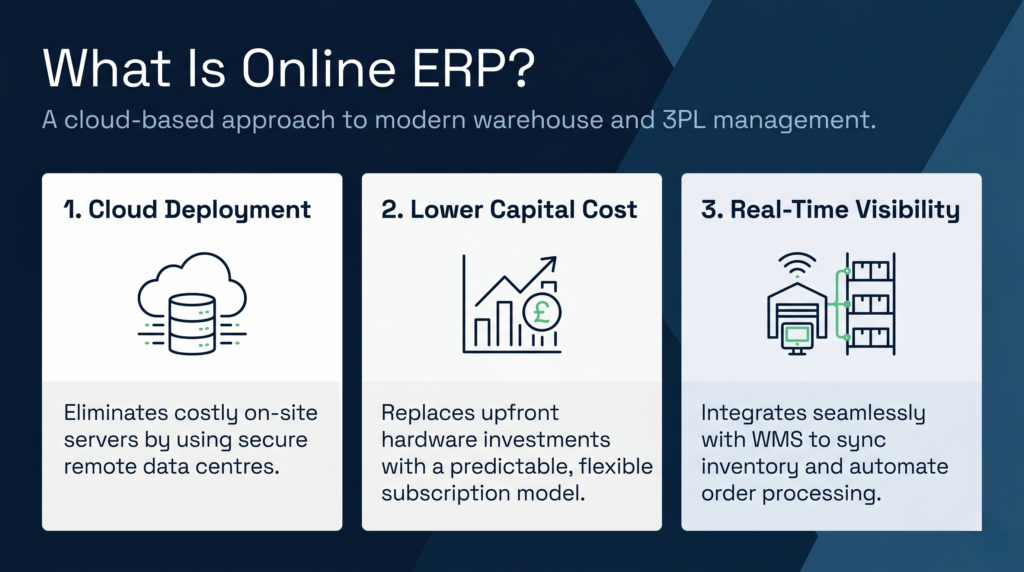
An ERP online—or cloud-based enterprise resource planning system—is a centralised software platform that manages core business processes across finance, procurement, inventory, manufacturing, and human resources via the internet. Unlike traditional on-premise systems installed on company servers, online ERP operates from remote data centres, accessible to authorised users from anywhere with a secure connection. For UK warehouse and 3PL operations, cloud ERP delivers real-time visibility into inventory, orders, and finances without the burden of maintaining costly on-site infrastructure.
The UK ERP software market reached USD 6,750.6 million in 2025 and is projected to grow to USD 12,975.4 million by 2033 at a compound annual growth rate of 8.7%, with cloud-based deployments capturing 58.4% of market revenue. This shift reflects a fundamental change in how UK businesses—from SMEs to large enterprises—manage operations.
Why is online ERP different from traditional systems?
Traditional ERP systems require significant upfront capital investment in servers, hardware, and dedicated IT staff. Online ERP follows a subscription model, spreading costs over time and eliminating the need for complex on-site infrastructure. Cloud providers manage updates, security patches, and system maintenance, freeing your team to focus on operational priorities rather than technical administration.
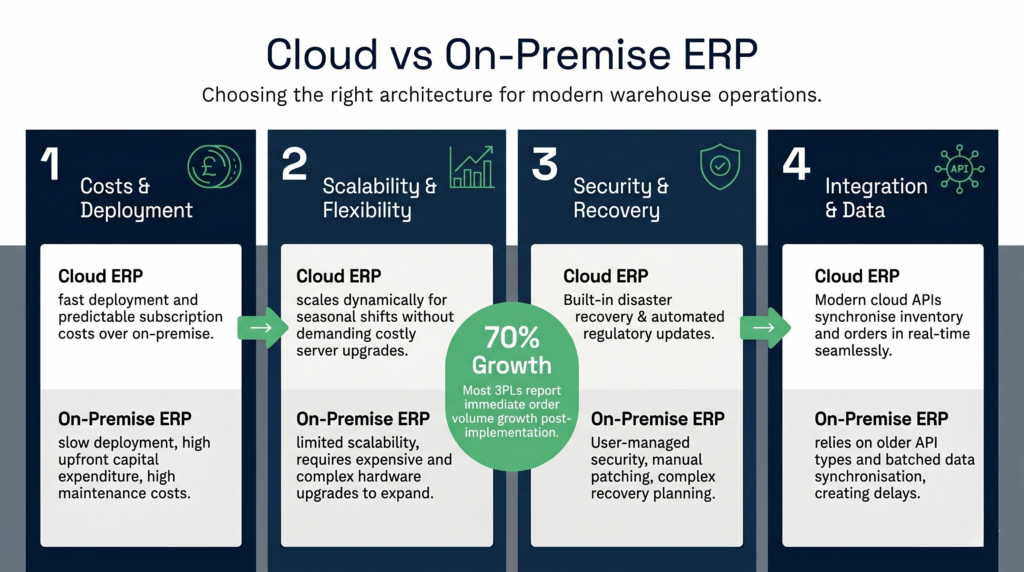
For 3PLs and warehouse operators, this shift is particularly valuable. A cloud ERP integrates seamlessly with warehouse management systems, enabling real-time inventory synchronisation and automated order processing. When 70% of 3PLs implementing WMS solutions report order volume growth post-deployment, the integration between WMS and ERP becomes a competitive advantage.
Who uses online ERP systems?
Online ERP serves manufacturers, distributors, retailers, logistics providers, and professional services firms. In the UK, manufacturing remains the largest segment, driven by the need for automated production planning and supply chain optimisation. However, logistics and distribution companies increasingly adopt cloud ERP to meet customer demands for real-time tracking and compliance with regulations like Making Tax Digital—now mandatory for VAT-registered businesses since April 2022.
What is the best free online ERP?
Free ERP options exist, but they come with trade-offs between cost savings and functionality. Open-source platforms like ERPNext, Odoo, and Dolibarr offer zero licensing costs and full customisability, making them attractive to startups and micro-enterprises. However, free systems typically lack dedicated support, advanced AI automation, and pre-built industry workflows essential for logistics and 3PL operations.
Popular free online ERP options
- ERPNext: Open-source, community-driven, and built on a customisable framework. Ideal for businesses comfortable managing their own implementation and support.
- Odoo: Fully integrated all-in-one platform with modules for CRM, sales, inventory, manufacturing, and accounting. Over 2 million users worldwide; both free and paid tiers available.
- Dolibarr: Lightweight, open-source solution designed for small businesses, sole traders, and SMEs. Covers invoicing, contracts, inventory, and payments.
The hidden costs of free ERP
Although licensing is free, implementing and maintaining an open-source ERP requires time and expertise. Project teams must handle customisation, integration with existing systems (like a 3PL management system), and ongoing support. Research indicates that even “free” systems demand substantial labour investment—often consuming hundreds of hours across configuration, testing, and staff training.
For warehouse and 3PL operations, this labour burden becomes significant when integrating WMS, shipping software, and accounting systems. A cloud-native ERP like Sage ERP for ecommerce or Bitrix24’s free online ERP may provide a better value proposition when time savings and integration simplicity are factored in.
Is SAP a CRM or an ERP?
SAP is an enterprise resource planning (ERP) system, not a customer relationship management (CRM) platform. However, this distinction matters less in practice because SAP combines back-office ERP functionality with integrated CRM capabilities—making it a comprehensive solution for organisations managing both internal operations and customer-facing processes.
Understanding the ERP vs CRM distinction
ERP software manages the “back office”: finance, accounting, procurement, manufacturing, inventory, and human resources. CRM software manages the “front office”: customer data, sales pipelines, marketing campaigns, and service workflows. SAP, as an ERP system, excels at centralising core business processes across departments like finance, supply chain, and HR. It also includes sales and service modules that rival dedicated CRM platforms.
In contrast, Salesforce is a pure CRM platform focused exclusively on customer relationship management. Salesforce cannot manage procurement, inventory, or financial accounting at the level an ERP requires. However, companies frequently use both together—Salesforce for sales and marketing, SAP for operations—to capture the strengths of each.
SAP vs Oracle vs other enterprise systems
SAP and Oracle both offer comprehensive ERP solutions. SAP implementations typically complete in 4 months on average, while Oracle implementations average 22 months—reflecting Oracle’s more modular, cloud-first architecture. Pricing differs markedly: SAP customers typically spend around 4% of annual revenue on ERP, whereas Oracle customers spend closer to 1.7%. For SMEs, Oracle Cloud ERP (starting at USD 99 per month via NetSuite) or Capterra’s ERP directory offers comparison tools to match systems to budget and operational needs.
How does a cloud ERP differ from on-premise?
Cloud ERP and on-premise ERP differ fundamentally in deployment model, cost structure, maintenance burden, scalability, and disaster recovery. Cloud ERP runs on remote servers accessed via the internet; on-premise ERP installs on company-owned servers. This single difference cascades across operations, security, and strategic flexibility.
Cost and implementation timeline
On-premise ERP demands substantial upfront capital expenditure—often £500,000 to several million pounds for enterprise deployments. Implementation timelines stretch from 18 to 36 months. Cloud ERP follows a subscription model with predictable monthly or annual costs, typically enabling faster deployment (3–6 months) and lower initial outlay. For UK warehouse and 3PL operations managing tight cash flow, the financial predictability of cloud solutions is substantial.
Scalability and flexibility
Cloud ERP scales dynamically. As your business grows—adding new sites, users, or modules—cloud systems adjust resources instantly without infrastructure investment. On-premise systems require capacity planning and server upgrades, creating delays when expansion is urgent. For 3PLs scaling rapidly or handling seasonal fluctuations, cloud ERP’s elasticity is operationally critical.
Security and disaster recovery
Cloud providers invest far more in encryption, access controls, redundancy, and monitoring than most organisations can justify internally. Cloud ERP includes built-in disaster recovery across multiple geographically distributed data centres, ensuring business continuity. On-premise systems place the burden on internal IT teams to plan, test, and maintain recovery procedures—a substantial commitment many SMEs underestimate.
UK regulations—including UK GDPR and Making Tax Digital compliance—are integrated into modern cloud ERP by default. Your cloud provider handles regulatory updates, freeing your compliance team from constant reconfigurations.
Customisation and integration
On-premise ERP traditionally offers greater customisation flexibility, allowing deep modifications to workflows and data models. Cloud ERP’s architecture prioritises standardisation and rapid deployment, limiting bespoke customisation. However, modern cloud ERP platforms offer extensive integration via APIs and pre-built connectors to Clarus WMS integrations, accounting software, and shipping platforms—enabling seamless data flow without heavy customisation.
For warehouse operators, this distinction is crucial. Cloud ERP with robust WMS integration capabilities can synchronise inventory, orders, and financials in real-time, whereas on-premise systems often require custom middleware or manual data reconciliation.
How does ERP integrate with warehouse management?
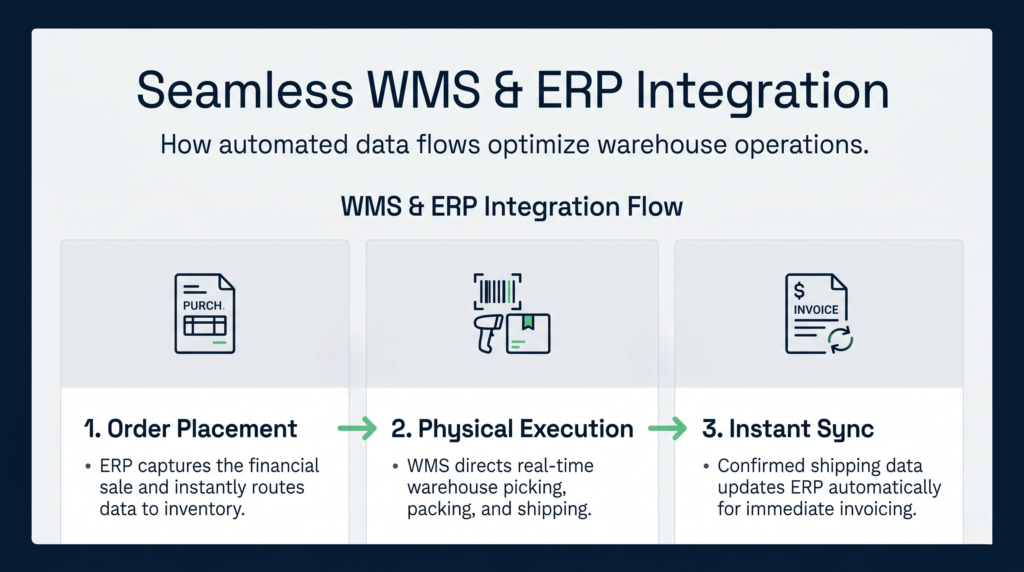
ERP and warehouse management systems (WMS) are complementary but distinct. ERP manages financial transactions, purchase orders, and inventory valuation; WMS controls physical warehouse operations, picking, packing, and shipping. Integration between the two creates a unified supply chain platform where orders flow automatically from ERP to WMS, inventory adjustments sync in real-time, and shipping confirmations update accounting records instantly.
Real-world integration benefits
An integrated ERP-WMS environment eliminates manual data entry between systems, reducing errors and accelerating order processing. When a customer places an order in ERP, WMS receives it instantly, picks and packs inventory, and returns confirmed shipment data to ERP for invoicing and revenue recognition. This seamless flow reduces order-to-delivery time and improves inventory accuracy.
The UK warehouse automation market is projected to reach £2.7 billion by 2030, growing at 19.5% annually, with integration between ERP and automation platforms becoming standard. However, 30% of integration projects overrun budgets, and timelines slip by up to 12 months—underscoring the importance of selecting ERP platforms with proven ERP integration documentation and support.
3PL-specific integration requirements
3PL providers manage inventory for multiple clients, each with different ERP systems. A robust 3PL WMS must integrate with client ERPs via secure APIs or EDI connections. Clarus WMS, as a cloud-native 3PL solution, is designed to integrate seamlessly with customer ERP systems—whether Sage, SAP, Oracle, or smaller platforms—ensuring real-time visibility and automated settlement billing.
This integration capability is why 56% of 3PLs with integrated WMS-ERP platforms achieve strong profitability. By automating inter-system communication, 3PLs reduce manual reconciliation, accelerate billing cycles, and free staff for higher-value activities.
Why Clarus WMS integrates with your online ERP
Clarus WMS is built as a cloud-native warehouse management platform designed specifically for 3PLs and multi-site logistics operations. Its modular architecture connects seamlessly to online ERP systems via standard APIs and pre-configured integrations, enabling real-time synchronisation of inventory, orders, and shipment data.
By choosing Clarus WMS alongside your online ERP, you eliminate the integration delays and custom development costs that plague legacy WMS deployments. Our platform is built for cloud-first workflows, supporting UK compliance requirements (Making Tax Digital, GDPR) and modern multi-tenant 3PL operations without legacy infrastructure constraints.
To explore how Clarus WMS and your cloud ERP can work together, review our Clarus WMS pricing and contact our team to discuss your integration needs.
References
- UK ERP Software Market Size & Outlook, 2026-2033 — Grand View Research. https://www.grandviewresearch.com/horizon/outlook/erp-software-market/uk
- Cloud ERP Survey: UK Midmarket Manufacturing Results — Forterro. https://www.forterro.com/en/news/cloud-erp-survey-uk-midmarket-manufacturing-results
- UK Warehouse Automation Market Trends: Growth, Investment, and Future Outlook — OPEX. https://www.opex.com/en-gb/insights/uk-warehouse-automation-market-trends/
- What Is A 3PL WMS? | How To Choose The Right System — Extensiv. https://www.extensiv.com/blog/3pl-warehouse-management-system
- Preparing for Making Tax Digital in 2026: What U.K. businesses should know — Avalara. https://www.avalara.com/blog/en/europe/2025/12/uk-making-tax-digital-2026-guide.html
- CRM vs ERP: What’s The Difference? — NetSuite. https://www.netsuite.com/portal/resource/articles/erp/erp-vs-crm.shtml
- SAP Vs Oracle ERP Comparison – Operational Stability and Post-implementation benefits — Fingent UK. https://www.fingent.com/uk/sap-vs-oracle-operational-stability-and-post-implementation-benefits/
- Top free ERP and open source systems (plus hidden costs) — ERPFocus. https://www.erpfocus.com/top-free-erp-systems.html
- Top 9 open source ERP systems to consider — Opensource.com. https://opensource.com/tools/enterprise-resource-planning
- Cloud ERP vs On-Premise ERP for Manufacturing — AstraCanyon. https://www.astracanyon.com/blog/cloud-erp-vs-on-premise-erp-for-manufacturing