

What is the difference between ERP and WMS?
An Enterprise Resource Planning (ERP) system is a centralised business platform that integrates finance, human resources, procurement, and supply chain management across an entire organisation. A Warehouse Management System (WMS) is a specialised software solution designed exclusively to optimise warehouse and inventory operations—receiving, storage, picking, packing, and shipping. The key distinction: ERP manages the business broadly, whilst WMS manages warehouses specifically. According to Inbound Logistics analysis on the ERP or WMS question, the decision between the two depends on operational complexity and scale. Most modern organisations don’t choose one over the other—they choose both, configured to work together.
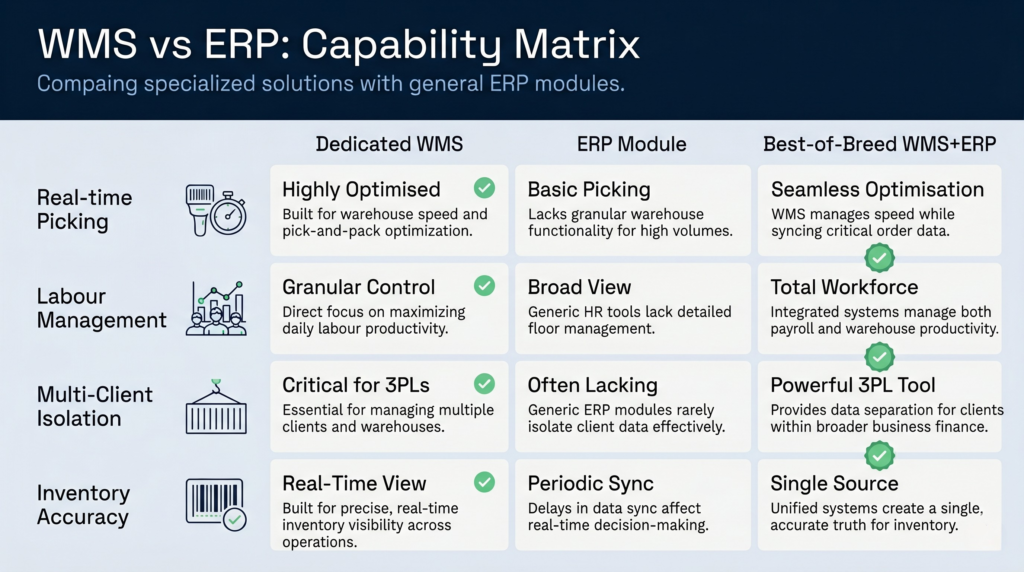
ERP systems centralise data across departments but often lack the granular warehouse functionality required for high-volume operations. A WMS, by contrast, is built for warehouse speed and accuracy. BlueLink’s comparison of WMS vs ERP highlights that WMS platforms excel at real-time inventory visibility, pick-and-pack optimisation, and labour productivity—capabilities that generic ERP modules cannot match. For 3PLs juggling multiple client warehouses with differing requirements, the distinction becomes critical.
How do ERP and WMS differ in daily operations?
In the warehouse itself, the differences are immediate. An ERP system processes transactions—it records that “Item X was picked from Location A”—but doesn’t orchestrate the optimal picking route or manage labour allocation in real time. A WMS does exactly that. It directs warehouse staff to the most efficient locations, batches picks by zone, calculates the shortest walking paths, and updates inventory counts instantly. For a 3PL managing multiple customer inventories, this precision is non-negotiable. ERP systems typically update inventory in batch cycles (hourly or daily); purpose-built WMS platforms deliver real-time synchronisation.
Can ERP replace a WMS?
Technically, ERP systems include basic warehouse management modules. In theory, a single platform should be simpler and cheaper than running two. In practice, ERP warehouse modules are rarely sufficient for operations processing more than 50,000 picks per month. According to industry analysis, companies attempting to replace a specialised WMS with an ERP module alone report 20–30% lower picking efficiency, higher inventory discrepancies, and increased labour costs. The reason is architectural: ERP software is built for transactional accuracy and financial reporting, not operational speed.
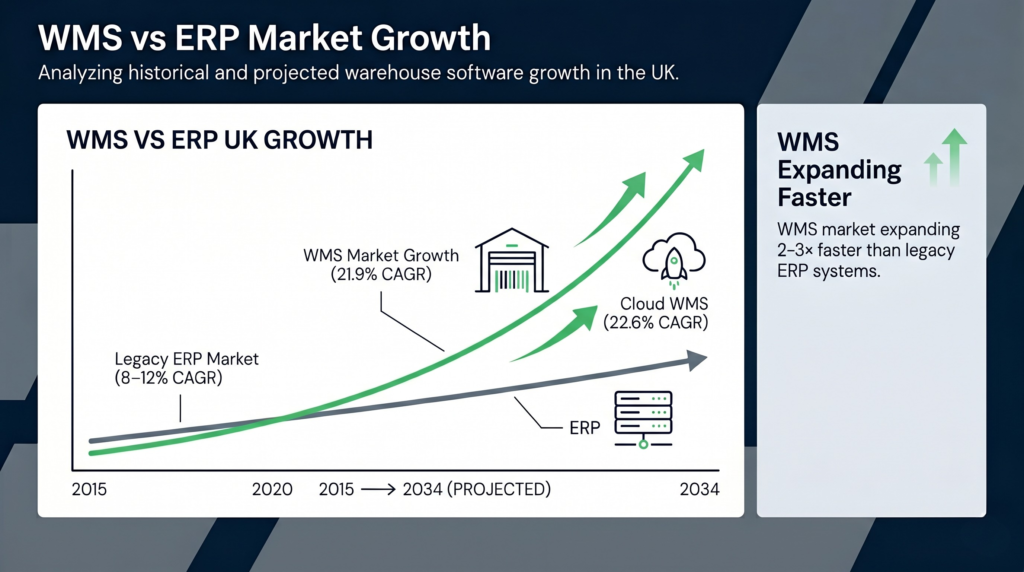
Many organisations discover this costly lesson after implementation. Software Advice’s guidance on WMS vs ERP vs SCM for 3PLs confirms that dedicated WMS solutions consistently outperform ERP modules for 3PL operations. The market data supports this: the global WMS market was valued at $3.38 billion in 2025 and is projected to reach $15.95 billion by 2033, growing at a 21.9% compound annual growth rate. If ERP modules were truly sufficient, this specialised market would not be expanding at such velocity.
Where ERP modules fall short
ERP warehouse components typically lack multi-client tenant separation, meaning 3PLs cannot isolate one customer’s inventory from another within the same module. They also lack advanced labour management, slotting optimisation, and the real-time RFID or barcode integration that modern warehouses expect. Setup time is longer—ERP implementations for warehousing can take 18–24 months—whereas dedicated WMS platforms deploy in 6–10 weeks. For 3PLs needing to onboard clients quickly, this is a critical gap.
When do you need a dedicated WMS vs an ERP module?
The answer depends on three factors: transaction volume, operational complexity, and client isolation requirements. If your warehouse handles fewer than 500 picks per day and operates a single client inventory, an ERP module may be adequate. If you process more than 1,000 picks per day, manage multiple client inventories, or require advanced labour scheduling and putaway logic, a dedicated warehouse management system is essential. For 3PLs, the threshold is almost always lower—most require a dedicated WMS from day one.
TechTarget’s analysis of best-of-breed WMS versus ERP advanced warehouse management shows that companies choosing specialised warehouse systems reduce operating costs by 15–25% within two years and achieve return on investment within 6–12 months. Those attempting to standardise on ERP modules alone often report 40–50% longer payback periods and lower realised efficiency gains.
Key decision criteria
- Multi-client inventory separation: Does your operation isolate inventories for multiple customers? A dedicated WMS handles this seamlessly; ERP modules struggle.
- Transaction velocity: Do you process more than 1,000 picks per day? ERP warehouse modules slow down at this throughput; purpose-built systems thrive.
- Rapid client onboarding: Must you configure new customer warehouses in days or weeks? Dedicated WMS platforms provide faster deployment; ERP implementations are lengthy.
- Integration ecosystem: Do you need real-time connections to carrier systems, 3PL TMS platforms, or customer ordering portals? Dedicated WMS solutions have broader third-party integration libraries.
- Advanced labour orchestration: Are labour productivity and real-time task assignment critical? Dedicated WMS excels; ERP modules offer basic task lists only.
Which is right for a 3PL—ERP or WMS?
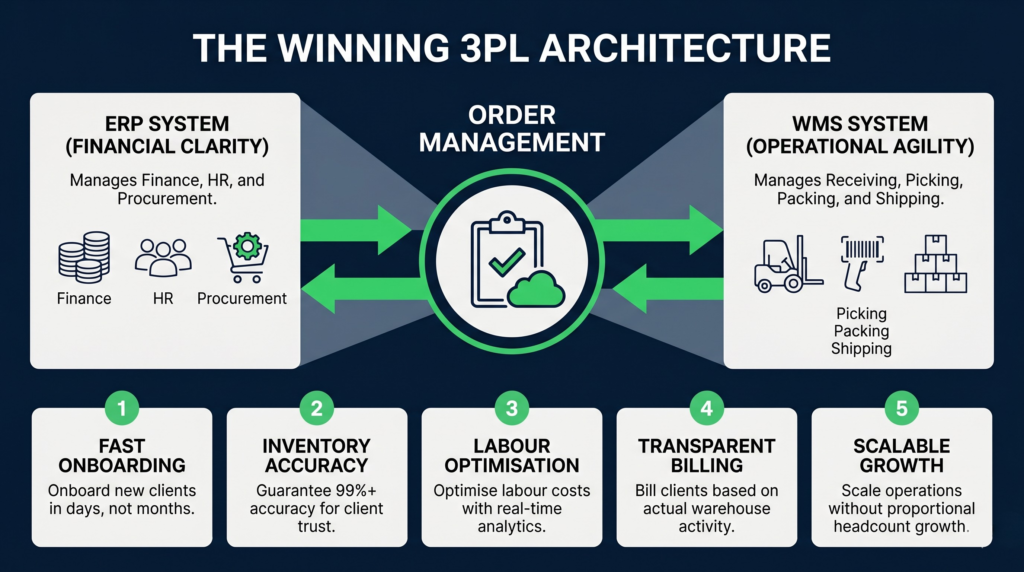
The honest answer: both. However, the 3PL-specific WMS should be the primary operational system, and the ERP should integrate with it. This hybrid approach is the industry standard. The Modex comparison of ERP vs best-of-breed WMS demonstrates that integrated configurations deliver superior performance to either system alone. A dedicated WMS manages the warehouse at speed; the ERP manages finance, procurement, and strategic reporting. The two systems synchronise inventory and transaction data in real time, eliminating data silos.
For 3PLs specifically, the WMS is the competitive differentiator. It directly influences client satisfaction through order accuracy, speed, and visibility. An ERP module that slows down or limits flexibility undermines the entire operation. A purpose-built 3PL management system manages the unique demands of multi-client logistics: separate P&Ls per client, client-specific billing, inventory segregation, and rapid onboarding. No generic ERP module provides this level of specialisation out of the box.
The integration imperative
The trend in the market is clear: integrated WMS-ERP ecosystems are becoming standard. The UK warehouse automation market reached £960 million in 2024, growing at 21% annually through 2030, driven by companies seeking tighter integration between warehouse operations and financial systems. Modern WMS integrations with ERPs enable real-time synchronisation of inventory, orders, and customer data, eliminating manual reconciliation and the errors it causes. Cloud deployment, now the default for new implementations, makes this integration seamless. The cloud segment for WMS solutions is growing at 22.6% annually through 2033, outpacing on-premise systems.
3PLs that choose a dedicated WMS and integrate it tightly with their ERP realise several competitive advantages: faster client onboarding, higher picking accuracy (99%+ inventory accuracy is standard), better labour productivity (25–30% improvements are typical), and transparent client reporting. These benefits translate directly to client retention and margin growth.
How do ERP and WMS systems work together?
In a well-designed integration, the WMS is the system of record for warehouse operations. It captures every receipt, pick, pack, and ship event in real time. The ERP consumes this data for financial reporting, cost accounting, and supply chain visibility. When a customer places an order through the ERP, the WMS receives it instantly and begins orchestrating fulfilment. When the WMS confirms shipment, the ERP records revenue and updates inventory on the general ledger. This real-time loop eliminates delays, reduces errors, and gives finance teams accurate, current data.
For 3PLs, the integration also manages client-specific workflows. The WMS enforces client-specific picking rules (e.g., “Customer A requires items sorted by SKU before packing”). The ERP bills each client separately, reconciling charges to actual warehouse activity. The two systems working in concert transform warehouse operations from a cost centre into a transparent, controllable business unit.
Why 3PLs need both systems—not one or the other
A 3PL’s fundamental business model requires operational flexibility and financial clarity. A WMS alone gives flexibility but no financial visibility. An ERP alone gives reporting but no operational agility. Together, they are unstoppable. A 3PL using a warehouse management solution integrated with its ERP can:
- Onboard new clients in days (or weeks, not months).
- Guarantee 99%+ inventory accuracy, building client trust.
- Optimise labour costs in real time using WMS analytics.
- Bill clients transparently based on actual warehouse activity.
- Scale operations without proportional headcount growth.
The market has spoken: the WMS segment is growing faster than ERP (21.9% CAGR for WMS vs historical ERP growth of 8–12%). This reflects reality: as operations become more complex, the warehouse becomes the differentiator, not the afterthought. 3PLs that invest in specialised WMS technology, integrated with their ERP, win market share from competitors still trying to manage warehouses through generic ERP modules.
Common struggles when ERP and WMS aren’t integrated properly
Many organisations experience chaos when ERP and WMS systems operate in silos. Inventory counts don’t match between systems, requiring manual reconciliation. Client orders sit in the WMS queue because the ERP hasn’t sent them. Billing disputes arise because the ERP records one quantity shipped whilst the WMS recorded another. Training becomes complicated—staff must learn two systems with inconsistent logic. These problems are entirely avoidable with proper integration architecture.
The solution is to start with a WMS purpose-built for your business model (3PL, B2B, B2C, pharmaceutical—each has different needs), ensure it has robust API connectivity to your ERP, and manage the integration from day one. Too many organisations attempt integration after the fact, creating months of technical debt and operational friction. The better approach: select a UK warehouse management system with proven ERP integration patterns, deploy with an integrated mindset, and reap the benefits immediately.
Get the integration right from the start
Choosing between ERP and WMS is not an either-or decision—it’s a design decision about how your warehouse and finance systems will communicate. For 3PLs and high-complexity operations, the answer is always the same: a purpose-built WMS integrated tightly with your ERP, deployed in the cloud for scalability, and managed as a unified operational ecosystem. This approach is faster to implement, simpler to support, and delivers measurable ROI in months, not years. The only organisations still debating “ERP or WMS” are those not yet running at scale. At scale, both are essential.