
Understanding WMS cost is one of the first hurdles any warehouse operator faces when evaluating new software. Ask five vendors for a quote and you’ll get five completely different numbers, different structures, and different definitions of what’s included. This guide cuts through that confusion. It covers what you’ll actually pay for a warehouse management system in the UK, what drives the price up or down, how SaaS and on-premise compare over time, and what hidden costs most buyers miss until it’s too late.
How Much Does a WMS Cost in the UK?
WMS cost in the UK varies enormously depending on deployment model, operation size, and vendor. Here’s a realistic overview of what you can expect to pay.
Cloud-based SaaS WMS
Most modern WMS platforms operate on a SaaS subscription model. You pay a monthly or annual fee, the vendor hosts and maintains the software, and you access it through a browser or mobile app. Pricing typically scales with the number of users, warehouse locations, or transaction volume.
For UK operations:
- Small operations (1-5 users, single site): £300 to £1,000 per month
- Mid-market (5-20 users, 1-3 sites): £1,000 to £3,500 per month
- Enterprise (20+ users, multi-site): £3,500 to £10,000+ per month
These figures cover the software subscription only. Implementation, training, and integration costs are additional.
On-premise WMS
On-premise systems require you to purchase a perpetual software licence and host the platform on your own servers or data centre. Upfront costs are substantially higher:
- Small operations: £15,000 to £50,000 for year one (licence plus implementation)
- Mid-market: £50,000 to £200,000 for year one
- Enterprise: £200,000 to £1,000,000+ for year one
On-premise systems also carry ongoing annual maintenance fees, typically 15-20% of the licence value, plus IT infrastructure and support costs. Over a five-year period, on-premise total cost of ownership usually exceeds SaaS for equivalent functionality.
Cost by operation size
| Operation size | SaaS monthly cost | On-premise year-one cost |
|---|---|---|
| Small (1-5 users) | £300-£1,000 | £15,000-£50,000 |
| Mid-market (5-20 users) | £1,000-£3,500 | £50,000-£200,000 |
| Enterprise (20+ users) | £3,500-£10,000+ | £200,000-£1,000,000+ |
For more detail on what drives pricing within each tier, see the ExploreWMS cost guide, which breaks down the components of WMS pricing in detail.
What Is the Average Cost of a Warehouse Management System?
Industry benchmarks from Software Advice’s WMS pricing analysis suggest the average WMS spend runs around £8,000 to £11,000 per user per year across all deployment types. However, this figure is skewed upward significantly by large enterprise deployments.
For small to mid-sized UK warehousing operations, the realistic annual spend on a SaaS WMS, including all fees, sits between £12,000 and £50,000 per year. Operations with complex integrations, multiple sites, or 3PL multi-client requirements sit toward the top of that range. Single-site operations with straightforward workflows sit toward the bottom.
It’s also worth noting that WMS pricing varies significantly by vertical. A 3PL WMS with multi-client billing, client portals, and carrier integration will cost more than a basic single-client warehouse system with no external integrations. Understanding exactly what you need before requesting quotes saves time and prevents inappropriate comparisons between very different platforms.
What Factors Affect WMS Cost?
WMS pricing isn’t arbitrary. These are the main variables that determine what you’ll pay.
Number of users
Most SaaS WMS platforms price on a per-user or per-named-user basis. More users means higher monthly costs. Some platforms offer concurrent user pricing instead, which can be more cost-effective if not all users are logged in simultaneously.
Watch out for how vendors define a user. Some count client portal logins as billable users. If you’re a 3PL with 15 clients all needing portal access, that can add significant cost to the headline per-user price. Understanding what a warehouse management system needs to do for your specific operation helps you ask the right pricing questions.
Transaction volume
Some vendors price on transactions processed rather than users. Higher pick volumes, more orders, or greater inbound receipt activity means higher costs. This model can work well for seasonal operations where volume fluctuates, but requires careful modelling to avoid bill shock in peak periods.
ustomisation requirements: Out-of-the-box software is cheaper to deploy than a heavily customised build. Every bespoke workflow or non-standard feature request costs time and money during implementation.
- Support and SLA tier: Standard support is usually included in a SaaS subscription, but dedicated account management, 24/7 helpdesk access, or guaranteed response times often cost extra.
- Hardware: Handheld scanners, label printers, and mobile devices aren’t included in software costs. A small operation might spend £5,000–£15,000 on hardware; a large warehouse could spend £50,000 or more.
For 3PLs, there’s an additional consideration: does the WMS support multi-client billing natively, or will you need to build workarounds? Systems not designed for third-party logistics tend to require more customisation, which pushes implementation costs higher. A purpose-built 3PL management system handles client separation and billing out of the box, which saves both time and money at the point of deployment.
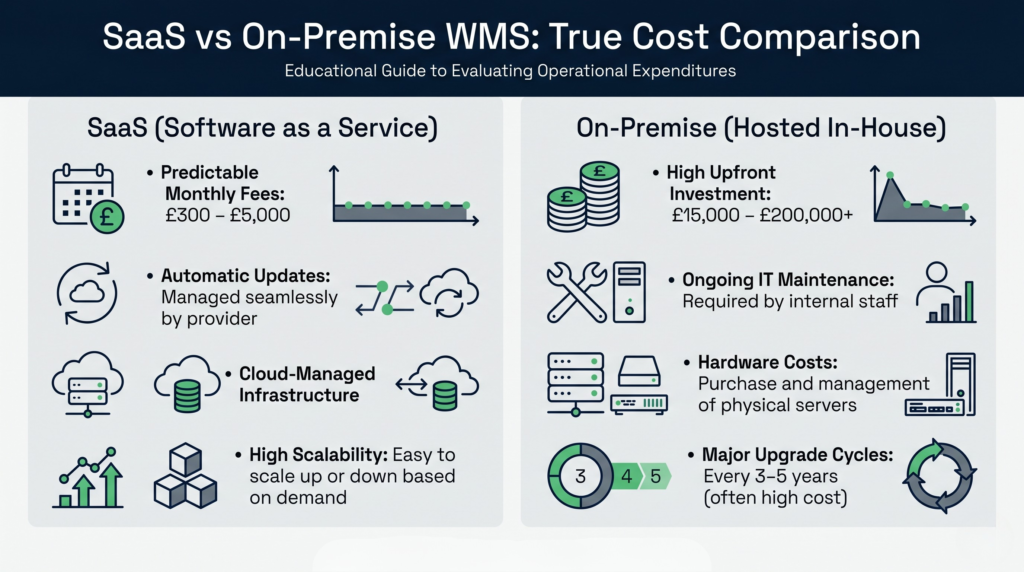
SaaS vs on-premise WMS cost: which is cheaper over time?
This is one of the most debated questions in warehouse technology. On paper, a perpetual licence looks cheaper after five or seven years than accumulating SaaS fees. In practice, the comparison is more nuanced.
A comprehensive TCO analysis published by Supply Chain 247 found that honest long-term modelling of on-premise systems almost always closes the apparent cost gap. Once you include server hardware (which needs replacing every five years), IT staff salaries, security patching, upgrade projects, and the cost of downtime during major version migrations, the five-year TCO of on-premise WMS typically exceeds most buyers’ initial estimates by 40–80%.
SaaS eliminates most of those hidden costs. Updates are automatic. Infrastructure is managed by the vendor. You don’t need a dedicated IT team to maintain the system. For growing operations, SaaS also scales without requiring new licence purchases; you add users or sites as needed.
That said, for very large enterprises already running mature on-premise infrastructure, the cumulative SaaS subscription fees over 10+ years can exceed the sunk cost of an owned licence. That calculation only holds if the on-premise system avoids costly upgrade cycles, which rarely happens in practice as integration requirements change.
The hidden advantage of cloud WMS for 3PLs
For 3PL operators specifically, SaaS WMS carries a structural advantage beyond cost: it lets you onboard new clients faster. On-premise systems often require IT involvement to create new client environments, configure access, or update integrations. Cloud-native platforms handle that through configuration, not code. That speed difference translates directly into competitive advantage and revenue.
If you’re evaluating your options for how to choose a WMS, deployment model is one of the first decisions to make. It sets the entire cost and operational structure for everything that follows.
What is the total cost of ownership of a WMS?
Total cost of ownership (TCO) captures everything you’ll spend over the lifetime of a system, not just the licence or subscription fee. For a realistic TCO model, you need to include these components.
- Software licence or subscription: The headline cost, either a monthly SaaS fee or a perpetual licence.
- Implementation and setup: Professional services to configure, test, and deploy the system. Typically £5,000–£60,000 depending on complexity. The WMS implementation process involves requirements gathering, data migration, integration development, user acceptance testing, and go-live support, all of which take time and cost money whether you’re doing it internally or with vendor support.
- Training: Staff need to learn the system. Expect 3–5 days of structured training for a warehouse team, plus ongoing refresher sessions as the team changes. Budget £2,000–£10,000 for an initial rollout.
- Hardware: Scanners, printers, mobile devices, Wi-Fi infrastructure if your warehouse doesn’t already have adequate coverage.
- Integrations: ERP, ecommerce, carrier, and customer-facing portal connections. Each integration has a build cost and an ongoing maintenance cost as connected systems release updates.
- Annual maintenance and support: For on-premise, typically 15–20% of the licence fee per year. For SaaS, usually included in the subscription.
- Upgrade costs: On-premise systems require major upgrade projects every three to five years. These can cost tens of thousands of pounds and often involve third-party consultants.
- Downtime and productivity loss: Any system transition causes temporary productivity dips. For a warehouse processing thousands of orders a day, even a partial-efficiency period costs real money.
According to research cited in Gartner’s analysis of the Warehouse Management Systems market, most organisations underestimate WMS TCO by a significant margin because they focus on the software cost in isolation rather than modelling the full operational picture. A rigorous TCO exercise almost always changes the shortlist.
Good inventory and warehouse management requires more than just tracking stock. It requires a system that keeps operating costs predictable over time, and that’s where the TCO conversation matters most.
WMS implementation cost: what to expect
Implementation is where many WMS budgets go wrong. It’s common for buyers to negotiate hard on the software licence price, then discover that the implementation bill is two or three times larger than anticipated.
A realistic implementation cost for a mid-market UK warehouse operation runs between £10,000 and £60,000. That wide range reflects the variation in complexity: a single-site, single-client operation with simple inbound and outbound flows will deploy much faster than a multi-client 3PL with complex billing rules, multiple carrier integrations, and bespoke put-away logic.
The main cost drivers during implementation are:
- Data migration: Moving product data, SKU hierarchies, and historical inventory from your old system (or spreadsheets) into the new platform. Poor data quality extends this phase significantly.
- Integration development: Each system connection (ERP, ecommerce platform, carrier APIs) requires development time. Budget £2,000–£8,000 per integration as a rough guide.
- Configuration and testing: Setting up workflows, labelling formats, user permissions, and running user acceptance testing before go-live.
- Go-live support: Having vendor staff on-site or on-call during the first days of live operation significantly reduces risk but adds to the bill.
One way to control implementation costs is to choose a system designed for your specific operating model from the start, rather than adapting a generic platform. A vendor whose system is pre-built for 3PL workflows will spend less time configuring the fundamentals, and that time saving passes directly to you.
Is there a free WMS?
Yes, free and open-source WMS options exist, but they come with significant caveats. Open-source platforms like Odoo (which has a free community edition) or OpenBoxes are technically available at no licence cost. In practice, deploying and maintaining them requires technical development resource: either internal developers or paid consultants. The “free” software quickly accumulates implementation and ongoing support costs that rival or exceed paid SaaS alternatives.
Free-tier cloud WMS products also exist, typically with strict limits on order volumes, users, or features. These can work for very small operations just starting out, but most UK warehouses processing more than a few hundred orders a week will outgrow them quickly.
The honest answer is: if your warehouse has meaningful volume and complexity, a free WMS will cost you more in lost productivity and customisation effort than a reasonably priced SaaS solution. The low upfront cost is rarely the full picture.
It’s also worth noting that some WMS vendors in the UK market, including larger legacy systems like those evaluated in Gartner’s reports, quote enterprise price tags that can put off SME warehouses. Cloud-native platforms built specifically for 3PLs and fulfilment businesses tend to offer more competitive pricing with faster deployment, without the enterprise licence overhead.
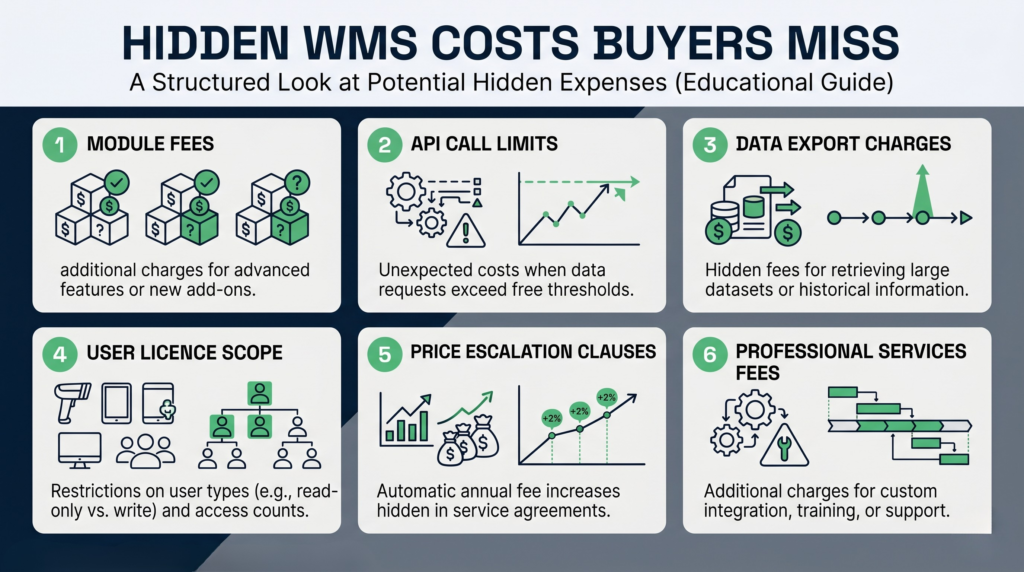
Hidden WMS costs buyers often miss
Beyond the obvious line items, several costs catch buyers off guard. Here’s what to watch for when reviewing any WMS proposal.
- Module fees: Many vendors sell the core WMS at an attractive price, then charge separately for modules like returns management, yard management, or advanced analytics. Check what’s included versus add-on before signing.
- API and integration call limits: Some platforms charge based on API call volumes. If you’re running high-frequency integrations with ecommerce platforms or carrier networks, this can add up fast.
- Data export and portability: If you want to extract your own data for reporting or eventually migrate to a different system, some vendors charge for data exports or make migration deliberately difficult.
- User licence scope: Check whether your licence covers only named users or includes read-only access for clients and external partners. Some vendors charge for every login, including customer portal access.
- Price escalation clauses: Multi-year SaaS contracts often include annual price increases of 3–10%. Over a five-year term, a £2,000/month subscription with 5% annual increases becomes substantially more expensive than the initial quote suggests.
- Professional services for changes: Even minor workflow changes sometimes require paid professional services in less configurable systems. Understand whether your team can self-serve on configuration or whether every change needs a support ticket and an invoice.