

What is ERP in the UK?
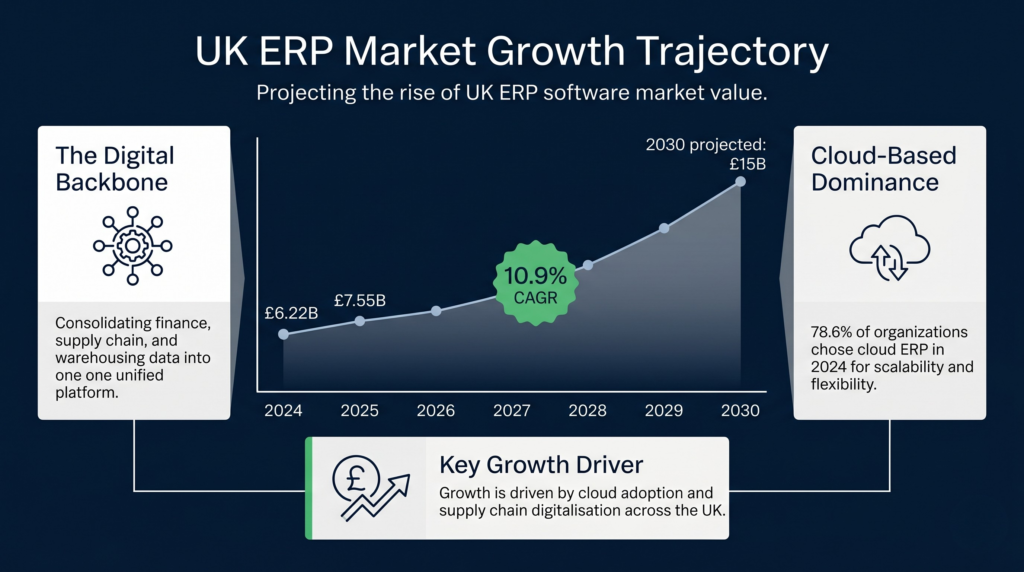
Enterprise resource planning (ERP) is software that consolidates data from across your business—finance, supply chain, warehousing, manufacturing, and customer management—into a single, unified platform. For UK companies, especially those managing complex warehouse and 3PL operations, ERP serves as the digital backbone connecting multiple business functions in real time.
The UK ERP market generated £6.22 billion in 2024 and is projected to reach £7.22 billion by 2026, growing at a compound annual rate of 10.9% from 2025 to 2030. Cloud-based solutions now dominate new implementations, with 78.6% of organisations choosing cloud ERP in 2024, driven by scalability, flexibility, and lower upfront costs.
Unlike general business software, ERP systems are purpose-built to handle the interconnected nature of modern supply chains. When integrated with complementary tools like Warehouse Management Systems (WMS), they create a cohesive operational environment where finance, logistics, and inventory data flow seamlessly across departments.
What are the four types of ERP?
ERP systems are classified into four primary deployment and architecture models that define how businesses implement and maintain them.
1. On-Premise ERP
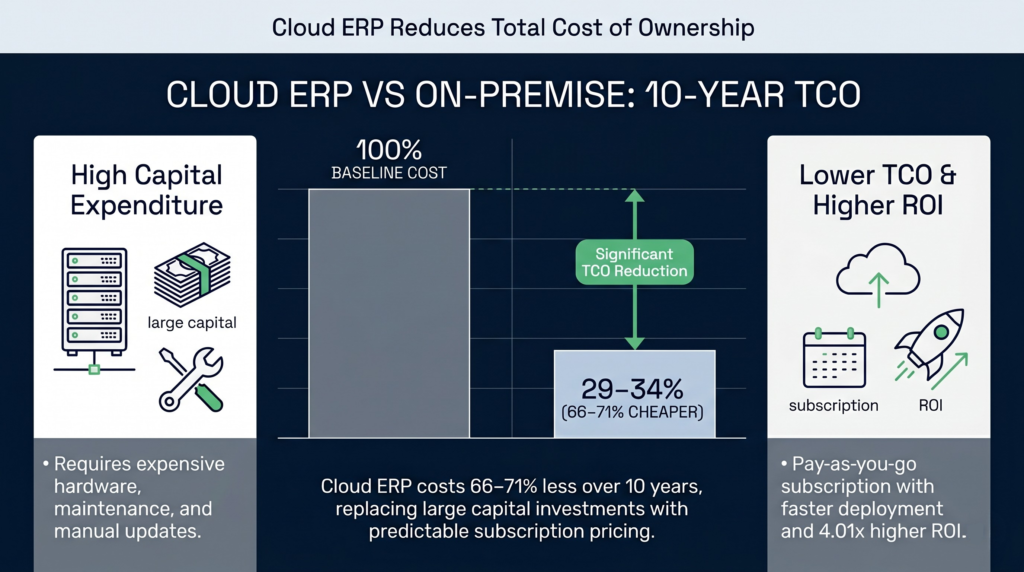
On-premise ERP runs on servers located within your company’s data centre. You own the infrastructure, manage updates, and control all security. However, on-premise systems cost 66–71% more over 10 years compared to cloud solutions due to hardware maintenance, IT staffing, and regular upgrade cycles. This approach suits large enterprises with dedicated IT teams and non-negotiable customisation requirements.
2. Cloud ERP (SaaS)
Cloud ERP (Software-as-a-Service) is hosted on the vendor’s servers and accessed via the internet. You pay a monthly or annual subscription, avoid infrastructure costs, and benefit from automatic updates. Cloud ERP delivers 4.01 times the ROI of on-premises systems, primarily due to faster deployment and lower capital expenditure. For UK 3PLs and mid-market logistics firms, cloud ERP offers the agility needed to scale warehouse operations across multiple locations.
3. Hybrid ERP
Hybrid ERP combines on-premise and cloud components. A global distributor, for example, might keep financial and HR systems in the cloud while managing warehouse operations on-premises, maintaining real-time warehouse control without sacrificing cloud scalability benefits.
4. Open-Source ERP
Open-source solutions like Odoo and ERPNext offer code transparency and reduced licensing costs. They appeal to cost-conscious UK manufacturers and small 3PL operators but require technical expertise for customisation and ongoing maintenance. These are less common in enterprise-scale warehouse operations.
What are the top 5 ERP systems?
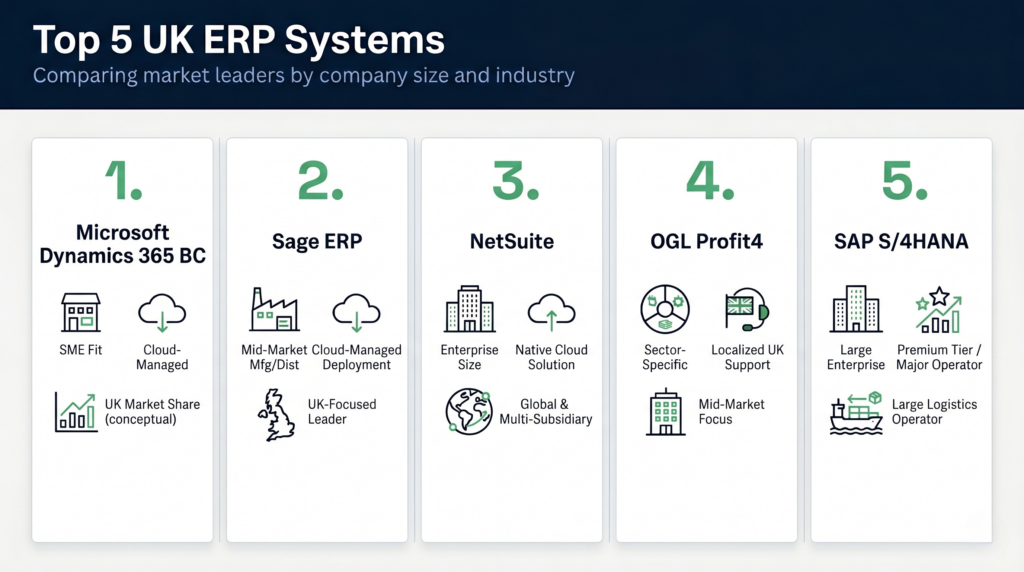
The UK ERP landscape includes established market leaders and cloud innovators. Here’s how the top five compare.
| ERP System | Best For | Deployment | UK Market Position |
|---|---|---|---|
| Sage ERP (Sage 200 / Sage X3) | Mid-market manufacturers and distributors | Cloud and on-premise | Market-leading in UK mid-market; familiar to UK accountants |
| NetSuite | Global enterprises; complex multi-subsidiary operations | Cloud only | Strong in large multinational logistics; native cloud architecture |
| Microsoft Dynamics 365 Business Central | SMEs already using Microsoft tools (Office 365, Teams, Power BI) | Cloud | Largest cloud ERP market share in UK SME segment (23.79% market share); 5,311 UK customers representing 12.24% of Microsoft’s ERP customer base |
| OGL Profit4 | UK mid-market; sector-specific (manufacturing, distribution) | Cloud and on-premise | Established UK provider with localised support |
| SAP S/4HANA | Large enterprises and multinational supply chains | Cloud and on-premise | Premium tier; used by major logistics and 3PL operators globally |
Sage ERP for UK businesses
Sage ERP remains the most familiar option for UK accountants and mid-market manufacturers. Sage 200 and Sage X3 are deployed in thousands of British companies and integrate well with UK payroll and tax compliance systems. Sage’s acquisition of Intacct strengthened its cloud offering, though many UK users remain on traditional on-premise deployments.
Microsoft Dynamics as an ERP solution
Yes, Microsoft Dynamics 365 Business Central is a full ERP system. It covers financials, sales, purchasing, inventory, manufacturing, project management, and warehousing in a single application. For UK organisations already invested in Microsoft’s ecosystem (Office 365, Teams, Power BI, Azure), Business Central offers seamless integration and familiar interfaces, reducing training overhead. Microsoft’s Azure UK data centres support data sovereignty requirements, and thousands of UK-based resellers provide implementation support.
How does ERP benefit UK warehouse and 3PL operations?
ERP systems deliver measurable improvements across warehouse and 3PL environments by centralising data, automating workflows, and enabling real-time visibility. When properly integrated with a 3PL Management System, ERP becomes the financial and operational command centre.
Real-time inventory visibility
ERP systems track stock levels across multiple warehouse locations, automatically updating inventory when goods move through receiving, picking, packing, and shipping. This eliminates manual reconciliations and stock-outs. For UK warehouse operators managing fast-moving consumer goods (FMCG) or automotive components, real-time data prevents costly expedited shipments and lost sales.
Integrated financial management
ERP consolidates purchase orders, goods receipts, invoices, and payments into a single ledger. Warehouse managers see the cost impact of inventory decisions instantly. For 3PLs billing customers by pallet, weight, or pick-count, ERP ensures accurate time-stamped transaction logs that support transparent invoicing.
Demand forecasting and planning
Advanced ERP modules use historical sales data to predict demand seasonality. UK distributors use this to adjust warehouse staffing and stock levels months ahead, reducing excess inventory holding costs. Real-time stock tracking and demand forecasting can significantly reduce inventory holding costs and prevent stock-outs.
Supply chain resilience
Post-Brexit supply chain friction and unpredictable labour availability have made resilience critical. ERP systems let UK logistics teams model scenarios: what happens if a supplier delays by two weeks? Can we reroute shipments through an alternate warehouse? This agility is essential for 3PL operators serving multiple customers with competing demands.
Return on investment
The average ERP project delivers a 52% ROI, meaning for every pound invested, companies see an average return of £1.52. Cloud ERP implementations generate even stronger returns: cloud ERP delivers 4.01 times the ROI of on-premises systems. UK 3PLs typically achieve full ROI within 6–12 months post-implementation, with recurring cost savings from reduced manual data entry and labour optimisation.
How does ERP integrate with warehouse management and 3PL systems?
ERP and WMS serve different—but complementary—functions. ERP manages the business side (finance, procurement, order management); WMS manages the physical operations (picking, packing, shipping, bin location, labour). When integrated via API or middleware, they create a frictionless operation.
Clarus WMS integrations with ERP systems mean that when a warehouse pick is completed, the system automatically updates inventory in the ERP, triggers invoicing, and notifies the customer of shipment. No spreadsheets. No phone calls. No reconciliation delays.
For UK 3PLs managing inventory on behalf of multiple brands, integration is non-negotiable. One 3PL operator worked with both a Sage ERP (managing their own operations) and a complementary WMS (managing customer inventory). The WMS fed real-time stock and shipment data back to the Sage system, enabling accurate billing and transparent reporting to customers. This two-tier approach—purpose-built 3PL management plus robust ERP—delivered £250,000 in annual savings by eliminating billing disputes and reducing manual reconciliation time.
Cloud-based systems accelerate integration. Cloud ERP solutions reduce total cost of ownership by 30–50% over five years compared to on-premise deployments, partly because integration costs drop when systems are already cloud-native and use REST APIs rather than legacy EDI connections.
What are the key considerations when choosing ERP for your UK operation?
Selecting an ERP system is a 7–15 year investment decision. Here are the most critical factors for UK warehouse, manufacturing, and 3PL leaders.
Industry-specific functionality
FMCG companies need batch/lot tracking and expiry date management. Automotive suppliers need serial number traceability and quality compliance. Pharmaceutical 3PLs need cold chain monitoring. Generic ERP systems often lack these; configurable or industry-specific variants do. Choosing the right ERP system is a defining decision for any UK manufacturer, with the system underpinning operations for the next 7–15 years.
Scalability and multi-location support
If your 3PL operates one warehouse today but plans to expand to three within three years, your ERP must scale without complete re-implementation. Cloud systems typically scale more gracefully than on-premise ones. Microsoft Dynamics 365 is designed to scale across multiple locations and geographies.
Integration capability
Your ERP will never be an island. It must connect to your WMS, TMS (transportation management), accounting software, e-commerce platform, and customer portals. Ask vendors: do you offer REST APIs? How many integrations have you built with UK WMS providers? How long does a typical integration take?
Total cost of ownership
List prices can deceive. Cloud ERP systems in the UK typically range from £1,000 to £10,000 per month depending on users and modules, with additional implementation costs. Factor in staff training, data migration, consultant days, and contingency. ERP implementation typically takes between 3 to 12 months depending on business size, system complexity, and customisation requirements.
Vendor stability and UK support
Choose a vendor with a UK team. Time zone matters. If your system crashes at 10 p.m. on a Friday, you need someone in the UK who can respond within hours, not someone in California waking up Monday morning. Sage, Microsoft, and NetSuite all have significant UK presences. Smaller vendors may rely on reseller support.
Data security and compliance
UK businesses handling customer data must comply with GDPR. If your ERP stores personal information, ensure the vendor is DPA-compliant and offers UK data centre options. Security services provided by cloud ERP vendors often exceed what SMEs can afford to implement internally, with providers maintaining servers in far better secured facilities than most companies can achieve.
How Clarus WMS complements your ERP strategy
ERP excels at business logic and finance; WMS excels at physical warehouse operations. The best-performing 3PLs and logistics operators use both.
Clarus WMS is a purpose-built warehouse management system designed for UK 3PLs, multi-channel retailers, and logistics operators. It handles the tactical day-to-day: receiving goods, assigning bin locations, optimising picks, managing labour, and generating shipment documentation. Your ERP handles the strategic: procurement, demand planning, customer invoicing, and financial consolidation.
When Clarus WMS is connected to your ERP via API, every warehouse action updates your financial records instantly. A completed pick automatically reduces inventory in your ERP. A shipment confirmation triggers customer invoicing. This real-time connection eliminates the reconciliation burden that slows manual operations.
For UK 3PLs specifically, Clarus WMS pricing is transparent and scales with your operation. Unlike enterprise ERP implementations that take 9–12 months to deploy, Clarus goes live in weeks. And unlike generic warehouse modules embedded in larger ERP suites, Clarus is optimised for 3PL-specific workflows: multi-customer inventory management, cross-docking, kitting, and pick-and-pack efficiency that directly boosts warehouse profitability.
The result: your ERP stays focused on finance and strategy. Your WMS stays focused on warehouse excellence. Together, they drive the efficiency and visibility that modern UK logistics demands.