

Running a wholesale or distribution business without the right software is like trying to manage inventory with a spreadsheet from 1995. You’ll waste hours on manual data entry, lose track of stock levels, miss order deadlines, and watch your margins shrink. The good news: today’s wholesale and distribution software solves these problems in real-time.
Whether you’re a fast-growing wholesaler struggling to keep up with orders or an established distributor looking to optimise operations, the right software platform becomes your competitive edge. It automates order processing, tracks inventory across multiple locations, manages customer relationships, and gives you visibility into every part of your supply chain.
But here’s the challenge: there’s no shortage of options out there. From traditional ERP systems to cloud-based distribution management platforms, the choices can feel overwhelming. So what software do wholesalers actually use, and which solutions are genuinely worth your investment?
In this guide, we’ll walk you through what wholesale and distribution software really does, how it differs from traditional ERP, what features matter most, and how to choose the best solution for your business.
What Software Do Wholesalers Actually Use?
Wholesalers and distributors rely on a mix of different software types, often working together in an integrated ecosystem. Understanding what each type does helps you make smarter buying decisions.
Warehouse Management Systems (WMS)
A WMS forms the backbone of most wholesale and distribution operations. It tracks inventory in real-time, manages stock across multiple locations, optimises picking and packing workflows, and ensures orders ship on time. Many wholesalers use a dedicated warehouse management system because it’s specifically built for the speed and accuracy warehouses demand.
The best distribution software includes advanced WMS functionality because distributors deal with high-volume, fast-moving inventory. A purpose-built WMS like Clarus reduces picking errors, speeds up order fulfillment, and gives you real-time visibility into what’s where.
ERP Systems
Enterprise Resource Planning (ERP) software connects finance, procurement, inventory, and customer data into one system. Solutions like Sage Wholesale Distribution and The Access Group offer comprehensive ERP modules designed for wholesale businesses. They handle purchasing, invoicing, order management, and reporting all in one place.
However, traditional ERP can be heavy, expensive, and slow to deploy. Many wholesalers find that distribution management software that combines a fast-moving WMS with lightweight financial modules works better than a bloated, all-in-one ERP system.
Order Management and e-Commerce Platforms
Modern wholesalers increasingly sell both B2B and D2C (direct-to-consumer). Platforms like Orderwise specialise in order routing, multi-channel selling, and customer self-service. These integrate with WMS and ERP to create seamless order-to-delivery workflows.
How Does Wholesale Distribution Software Differ From ERP?
This is a crucial distinction, and it often surprises business owners who assume ERP is always the right answer.
Speed and Flexibility
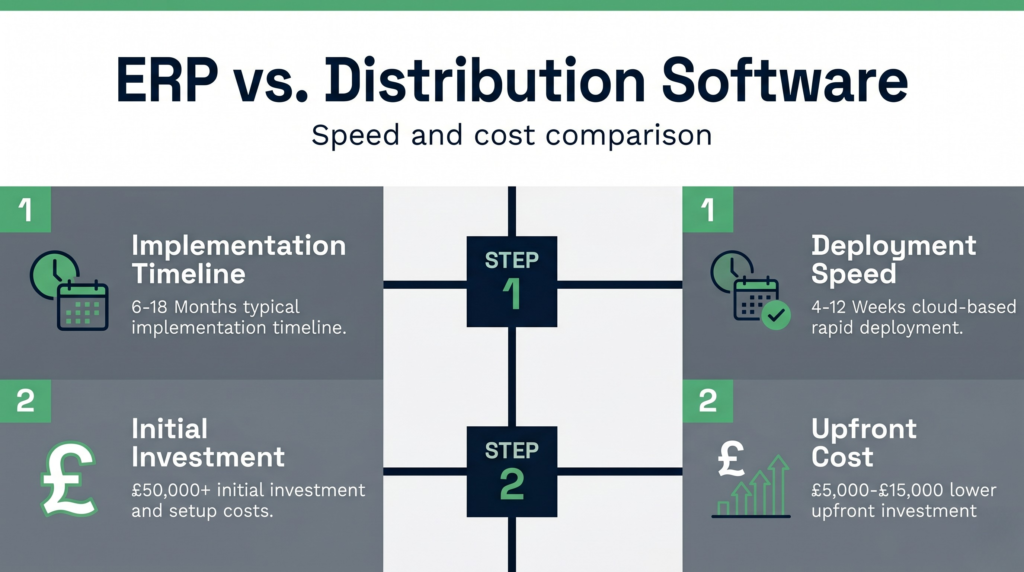
Traditional ERP systems are built for manufacturing and large enterprise operations. They’re comprehensive but rigid. A typical ERP implementation takes 6–18 months and costs tens of thousands of pounds.
Purpose-built wholesale distribution software prioritises speed and flexibility. It deploys in weeks, not months, and focuses on what wholesalers actually do: move stock fast, manage multiple suppliers, and keep customers happy. You’re not paying for modules you’ll never use.
Inventory-Centric vs. Finance-Centric
ERP systems treat inventory as a subset of financial management. They excel at tracking costs and creating balance sheet reports. But they often struggle with the operational realities of wholesale: multiple SKUs, fast inventory turnover, complex picking logic, and real-time stock visibility across warehouses.
True distribution ERP software and specialised WMS platforms flip this priority. Inventory management comes first because it directly impacts your ability to deliver orders and keep customers satisfied.
Scalability and Cost
ERP systems typically charge per user, per module, and per year. As you grow, costs explode. Specialised distribution management software often scales on transaction volume or warehouse throughput instead, meaning your costs grow with your business efficiency rather than your headcount.
What Features Should Wholesale and Distribution Software Have?
Not all software is created equal. These core features separate best-in-class solutions from mediocre ones.
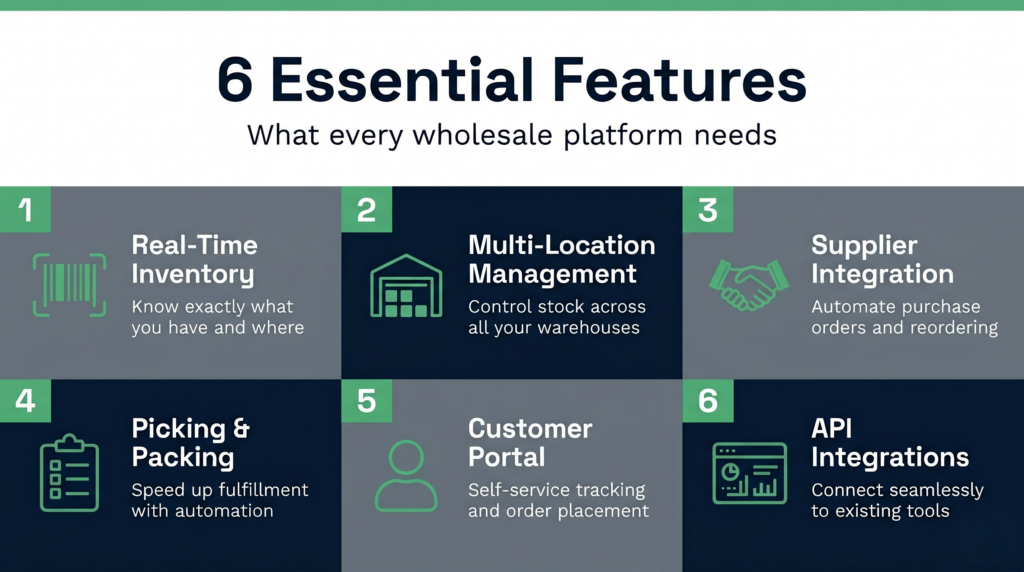
Real-Time Inventory Tracking
You need to know exactly what you have, where it is, and when it’s running out. Real-time tracking prevents stockouts, reduces waste, and ensures you’re not tying up capital in dead inventory. Look for systems that track inventory at SKU level across multiple locations and automatically flag reorder points.
Multi-Location Management
Most wholesalers operate from multiple warehouses, regional distribution centres, or third-party logistics hubs. Your software must handle inventory across all of them, optimise fulfillment by location, and prevent overselling. Distribution WMS solutions excel at this because they’re designed for distributed networks from the ground up.
Supplier and Purchase Order Management
Wholesale lives or dies by supplier relationships. Your software should manage purchase orders, track inbound inventory, handle supplier scorecards, and optimise reordering. The best systems automate reorder triggers based on demand forecasts, not just minimum stock levels.
Pick, Pack, and Ship Automation
Picking errors and slow fulfillment kill wholesale margins. Modern distribution software uses directed picking (the system tells workers exactly what to grab, in what order), barcode verification, and wave management to compress fulfillment time and reduce errors to near-zero.
Customer Self-Service and Visibility
B2B customers expect the same visibility you give your B2C shoppers. Real-time order tracking, stock availability checking, and invoice history should all be available in a customer portal. This reduces support tickets and improves retention.
Integration Capabilities
Your WMS doesn’t exist in isolation. It needs to talk to your accounting system, e-commerce platform, shipping carriers, and customer databases. The best WMS integrations happen automatically through APIs, not manual spreadsheet exports. Check that your chosen platform has pre-built connectors for the tools you already use.
Reporting and Insights
You need dashboards that show key metrics: order fulfillment rate, inventory turnover, supplier performance, and profit by customer. The software should make it easy to spot trends, identify problem areas, and make data-driven decisions. Avoid systems where getting a simple report requires IT intervention.
How Does a WMS Support Wholesale Distribution Operations?
A dedicated warehouse management system serves as the operational nervous system of wholesale and distribution. Here’s how:
Acceleration of Order Fulfillment
The faster you pick and ship orders, the faster you invoice and get paid. A purpose-built WMS optimises the physical workflow inside your warehouse: it groups orders into efficient picking waves, directs workers along the shortest paths, and automates pack-to-ship workflows. The result: orders that used to take a day to ship now ship in hours.
Reduction of Warehouse Costs
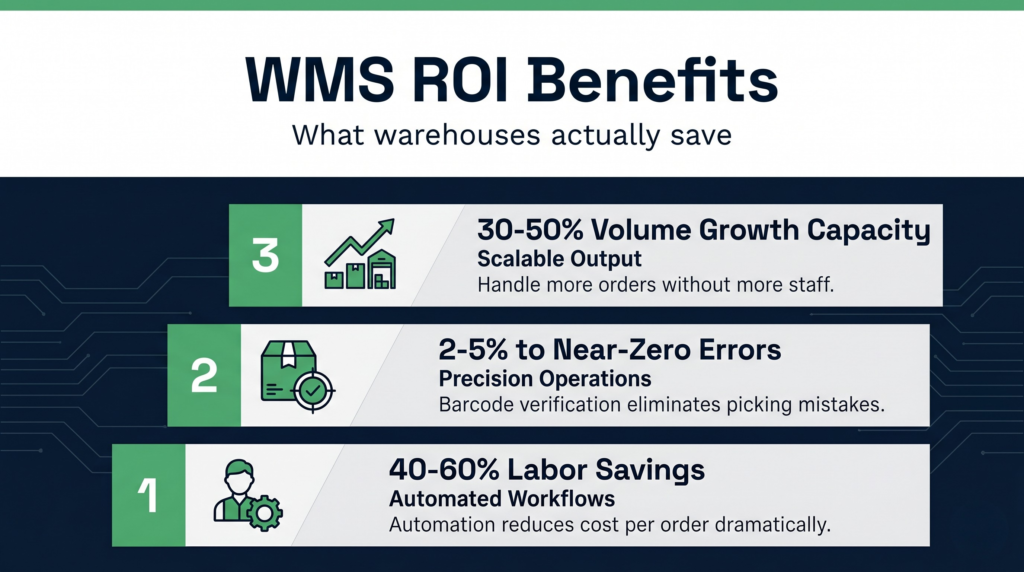
Labour is typically 40-60% of warehouse costs in distribution. A WMS reduces labour per order through automation, eliminates picking errors (which are expensive to fix), and improves space utilisation. Over time, these savings often exceed the cost of the software itself.
Accuracy and Compliance
Wholesale operations involve thousands of SKUs moving daily. Manual picking has error rates of 2-5%. A modern WMS cuts this to near-zero through barcode verification and system guidance. For regulated industries (food, pharma, chemicals), WMS also enforces lot tracking, expiry management, and audit trails that ERP systems often can’t handle efficiently.
Scalability Without Proportional Cost Growth
Grow your volume 50%, and labour-intensive manual processes grow 50% too. A WMS-driven warehouse can typically handle a 30-50% volume increase with minimal additional labour because the system creates efficiency gains as volume increases.
Best-in-Class Solutions for Wholesale and Distribution
Several platforms dominate the wholesale and distribution software space, each with distinct strengths:
Sage Wholesale Distribution
Sage Wholesale Distribution is a traditional ERP choice for mid-market distributors. It offers comprehensive financial management, order processing, and basic inventory tracking. It works well if you need tight integration between procurement, finance, and customer management. The trade-off: it’s slower to implement and heavier on cost than specialised solutions.
The Access Group Solutions
The Access Group provides cloud-based distribution software that bridges ERP and operational efficiency. It’s popular with mid-sized distributors who want more speed than traditional ERP but still need strong financial controls.
NetSuite Wholesale
NetSuite Wholesale is an oracle-owned cloud ERP that scales well for growing distributors. It offers global capabilities, strong financial reporting, and reasonable cloud pricing. However, warehouse operations functionality requires add-ons.
Orderwise
Orderwise specialises in order management and multi-channel selling for wholesalers and distributors. It excels at handling complex order routing, supplier management, and customer self-service portals. It’s lighter on ERP functionality but stronger on operational agility.
Comparesoft’s Distribution ERP Overview
If you’re evaluating multiple distribution ERP options, tools like Comparesoft help you benchmark features and pricing across platforms. Use these to validate your shortlist against your specific requirements.
The Real Cost of Choosing Wrong
Picking the wrong wholesale and distribution software isn’t just a financial mistake. It’s an operational one. Bad software choice leads to:
- Missed shipments and angry customers. When your system can’t keep pace with volume or complexity, orders fall through the cracks. You lose customers and damage your reputation.
- Hidden costs in manual work. If your software doesn’t automate key processes, your team has to compensate manually. This kills efficiency and burns out staff.
- Forecasting blind spots. Without good data, you either over-stock (tying up capital) or under-stock (losing sales). Both crush margins.
- Supplier relationship breakdown. Poor supplier data and forecasting lead to rush orders, late payments, and lost negotiating power. Your suppliers know when you’re disorganised.
The cost of failure often exceeds the investment in the right platform. A purpose-built solution designed for wholesale and distribution operations pays for itself through faster fulfillment, reduced errors, and lower labour costs.
Making Your Choice: Key Questions to Ask Vendors
Before you commit, push vendors on these points:
- How quickly can you go live? If they can’t give you a firm date within 12 weeks, be cautious. You don’t want to fund a year-long implementation.
- What’s included in the base cost? Many vendors lowball initial quotes, then add expensive modules, training, or per-user fees. Get a complete, itemized cost breakdown.
- How does pricing scale? As your volume grows, does the system cost grow with it? A good vendor partners with your growth; a bad one charges more as you scale.
- What’s your support model? Can you call a person or are you locked in email queues? Response time and support quality matter more than you’d think.
- Are there real customers like me? Ask for references from similar-sized wholesalers in your industry. Talk to them about implementation, ongoing costs, and whether they’d choose the vendor again.
Partnering for Distribution Success
Ultimately, choosing the right platform is about finding a technology partner that truly understands the unique pressures of the supply chain. As a proud member of the Federation of Wholesale Distributors (FWD), Clarus WMS is built specifically to handle the high-volume, fast-moving realities of modern distribution. By prioritising real-time inventory accuracy, seamless ERP connectivity, and agile cloud deployment over rigid, legacy frameworks, we help wholesalers optimise their workflows and protect their margins without the operational friction. If you’re ready to move past manual bottlenecks and scale your warehouse efficiency, Clarus WMS offers the practical, tailored support your operation needs to thrive.