

If you’re running a 3PL operation or managing ecommerce inventory, you already know that warehouse space is one of your biggest cost drivers. Every square metre counts, and how you use it directly affects your bottom line. Warehouse space optimisation isn’t just about fitting more pallets in — it’s about working smarter to serve your customers faster while cutting operational waste.
The challenge is real. Most warehouses operate at 60-75% capacity efficiency because they weren’t designed or managed with optimisation in mind. Unused vertical space, poorly arranged picking aisles, and inefficient product placement mean you’re paying rent on space you’re not truly using. But here’s the good news: with the right approach, you can unlock 20-30% more usable capacity without building an extension.
In this guide, we’ll walk you through proven warehouse space optimisation techniques that 3PL providers and ecommerce businesses across the UK are using right now to cut costs and speed up throughput.
Why Warehouse Space Optimisation Matters
Warehouse costs typically account for 10-15% of total supply chain expense. Within that budget, rent and utilities are often the largest line items. If you can optimise warehouse space and reduce the footprint you actually need, you’re looking at significant savings year-on-year.
Beyond cost, there’s a throughput angle. Better organised space means faster picking, fewer picking errors, and quicker despatch times. Your customers get orders faster. Your staff stress less. Shrinkage drops because inventory is easier to track and count. These aren’t ancillary benefits — they’re core to competitiveness.
For 3PLs especially, warehouse space utilisation is a margin driver. The more you can handle per cubic metre, the better your unit economics. Clients notice operational excellence, which builds retention and justifies rate increases.
Understanding Warehouse Layout Design
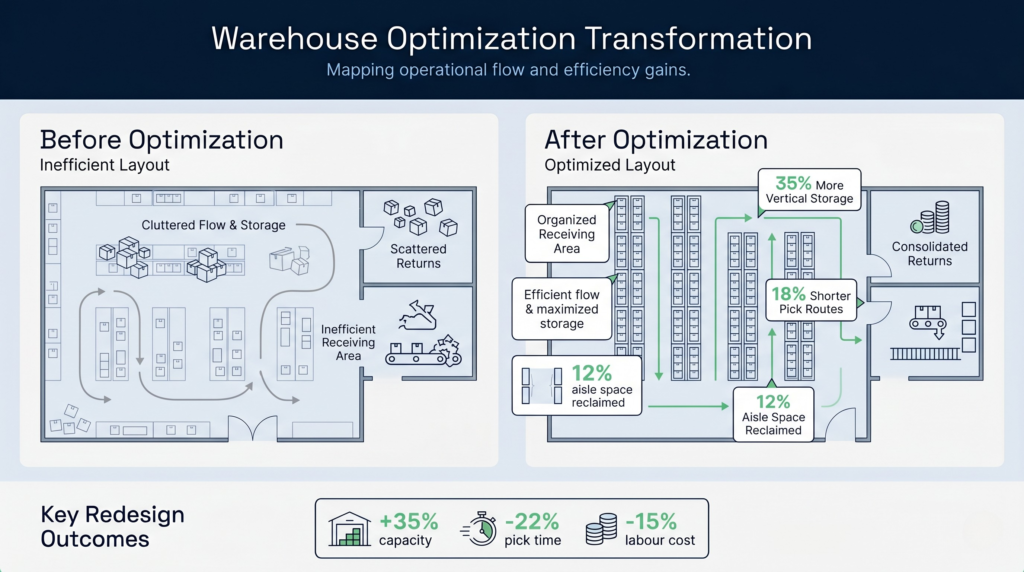
The backbone of any optimisation programme is your physical layout. A bad layout forces unnecessary movement, creates bottlenecks, and wastes floor space on inefficient aisles and dead zones.
Start with a warehouse layout checklist to audit your current configuration. Ask yourself:
- Receiving flow: Do goods move logically from inbound to storage to picking without backtracking?
- Aisle width: Are aisles wider than they need to be? Industry standard for counterbalance forklifts is 3.5m, but reach trucks can operate efficiently in 2.7m.
- Returns area: Is it separate from forward inventory to avoid mix-ups?
- Dead zones: Do you have corners or areas that serve no purpose?
The best layouts follow a U-shape or L-shape flow, with receiving at one end and despatch at the other. This minimises travel time and keeps the operation logical. Use warehouse mapping to visualise your current state and test layout changes before implementing them.
Vertical Storage and Warehouse Space Utilisation
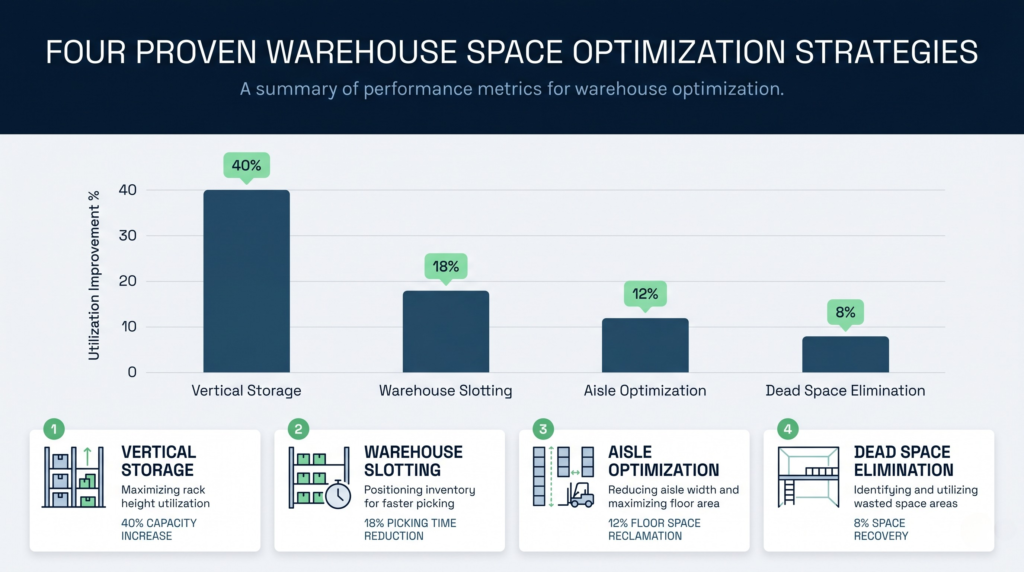
Here’s a statistic that surprises many operators: most warehouses use only 40-50% of their available vertical space. You’ve got 8, 10, even 12 metres of headroom, but inventory sits 1.5 metres high.
Vertical storage solutions transform that wasted cubic metre into revenue. Options include:
- Pallet racking: Standard selective racking lets you go 6-7 levels high. Easy to implement, no special equipment needed beyond a forklift.
- Drive-in racks: For bulk storage of fewer SKUs. Denser than selective racking but less flexible.
- Automated systems: Carousel systems, vertical lift modules (VLMs), and automated storage and retrieval systems (AS/RS) maximise density and speed. Higher capex but exceptional for high-velocity SKUs.
- Mezzanine floors: Add a second level for slower-moving items or light goods, effectively doubling usable space in that zone.
Your choice depends on your product mix and throughput. Light, fast-moving items suit automation. Bulky goods might stick with pallet racking. The key is matching the solution to your operation, not forcing one approach across the board.
Warehouse Slotting and Product Placement
You can have the best vertical storage in the world, but if you put slow-moving stock at eye level and hot SKUs at floor level, you’ve wasted the investment.
Warehouse slotting is the science of placing products where they should logically go based on velocity, size, and picking method. The principle is simple: high-velocity items go in the best (easiest to access) slots. Slow movers go high or far.
A proper slotting strategy might look like this:
- Zone 1 (Prime slot): Waist height, arm’s reach from aisle. Reserved for your top 20% of SKUs by velocity.
- Zone 2 (Good slot): One level above or below prime. Next 30% of SKUs by velocity.
- Zone 3 (Secondary slot): High or low positions. Slow movers, seasonal items, safety stock.
Slotting data comes from your warehouse management system. A good WMS tracks every pick, calculates SKU velocity, and can recommend or even auto-optimise your slotting. Reslotting every quarter keeps pace with changing demand patterns.
Aisle Optimisation and Traffic Flow
Aisles consume 20-30% of warehouse floor space. That’s intentional — pickers and equipment need to move — but many warehouses over-provision.
Start by measuring actual aisle width and comparing it to your equipment. A counterbalance forklift needs 3.5m, but if you’ve standardised on a 2.5m-wide reach truck, you don’t need 3.5m aisles everywhere. Reducing aisle width by 0.5m across 10 aisles in a 5,000 sqm warehouse frees up 250 sqm instantly.
Next, look at aisle placement. Are you running parallel aisles when a curved or angled layout would reduce congestion and improve visibility? Can you combine two slow-moving sections into one aisle? Modern warehouses often use “main streets” (wider, higher-traffic routes) and “secondary aisles” (narrower, for specialty items) to optimise flow without sacrificing safety.
Install traffic patterns and height markers. Make it clear to equipment operators where they should drive and where items should stack. Accidental damage — pallets crushed against racks, goods falling — wastes space and creates liability.
Warehouse Capacity Planning
You can’t optimise what you don’t measure. Capacity planning tells you how much space you actually have, how much you’re using, and where you can improve.
Three metrics matter:
- Gross usable space: Total square metres inside your warehouse.
- Allocated space: Storage racks, shelving, equipment areas, offices — space committed to specific functions.
- Utilised space: Space actually occupied by inventory right now.
Divide utilised by allocated, and you get your utilisation rate. Most operations run 60-75%. A world-class 3PL hits 85-90%. The gap represents your optimisation opportunity.
Your WMS should give you this data daily. If it doesn’t, you’re flying blind. With real-time data, you can spot slow-moving stock, identify obsolete inventory, and make data-driven decisions about holding costs, clearance sales, or returns.
Technology and Warehouse Management Systems
Manual optimisation — moving inventory around based on hunches — doesn’t scale. The best 3PLs and ecommerce operations use a warehouse management system as the nerve centre of optimisation.
A good WMS does several things:
- Tracks inventory in real-time: You know exactly where every SKU is, how fast it’s moving, and when it’s likely to need replenishment.
- Suggests slotting changes: Based on velocity trends, the system recommends which SKUs should move where.
- Optimises picking routes: Instead of random aisle traversal, the system sequences picks to minimise distance. Shorter routes = faster fulfillment = fewer aisles needed.
- Monitors space utilisation: Dashboards show you live capacity across zones, racking types, and storage tiers. You see bottlenecks instantly.
- Supports billing and automation: For 3PLs, the WMS ties storage costs to actual cubic metres used, enabling transparent billing and automating invoicing.
Clarus WMS is purpose-built for 3PLs and ecommerce operators in the UK. It integrates picking optimisation, slotting algorithms, and real-time capacity tracking into a single platform, so you can unlock space efficiency without guesswork.
Practical Steps to Start Optimising Today
You don’t need a complete overhaul to see results. Start small:
- Week 1: Walk the warehouse. Identify dead zones, narrow aisles that could be reduced, and slow-moving stock in prime locations.
- Week 2: Run a velocity analysis. Which SKUs move daily? Weekly? Monthly? This data guides your slotting strategy.
- Week 3: Reslot your top 200 SKUs into optimised positions. Move fast movers to prime slots, slow movers to secondary zones.
- Week 4: Measure the impact. Track picking time per order, space utilisation, and errors. You should see a 5-10% efficiency gain immediately.
Once you’ve proven the value, plan bigger moves: aisle reduction, vertical storage investments, or system upgrades.
Common Mistakes in Warehouse Space Optimisation
We see these pitfalls repeatedly:
- Investing in equipment before fixing process: A new racking system won’t help if your slotting is chaotic. Optimise your operation first, then invest in infrastructure.
- Ignoring safety: Squeezing more into less space is false economy if it creates injury risk or regulatory non-compliance. Always prioritise safe working conditions.
- One-off reslotting: Slotting needs to happen regularly — quarterly at minimum — because demand patterns shift. Build it into your standard operating procedure.
- Neglecting peak season planning: Optimisation works great at steady state, but Christmas or spring surge periods expose capacity limits. Plan for peak or you’ll lose sales.